So I was reading/listening to Midwinter and I was kind of wondering if you had any general ideas on what the elvish dance would look like and the kind of music it would be to? I really want to try and recreate it to the best of my ability!

Hey Nonnie – I hope you liked Midwinter 🙂

I went for a little expedition through my blog just then, and do you know? I had totally forgotten that I had written this! It’s a general description of what I imagine Elvish dancing to look like, and the themes of the most popular holiday dances!

Dang, my memory is slipping, hehehhe.

Music-wise, I feel that the Elves would be more inclined towards collaborative music that ebbs and flows and never quite reaches a “formal” climactic moment as is common in Western classical tradition
 I don’t think there’d be huge orchestras but instead small quartets, trios, chamber groups. A small group of virtuosos who know each other’s talents and thoughts so intimately that they are able to grow the music as they play it. Indonesian gamelan springs to mind, as does Bugaku (Gagaku) or Indian classical music. Music that takes its inspiration from the sounds of nature, too: the calls of birds and forest creatures, the long slow growth of trees, the sound of waves crashing upon a sandy shore


I don’t think they’d be into short music – even folk/history songs (such as the Lay of Luthien) go on FOREVER AND EVER oh god so many stanzas, and so perhaps instrumental music is the same: slowly building, forming and increasing in intricacy, undercurrents of passion that never pierce that sense of continuity and movement
 before it breaks apart, melding again in a new configuration


Vocal music is obviously a massive part of their lives: Legolas never stops singing, and neither does Galadriel! So there’d be different songs for different clans of elf, I guess
 some would be formal and some would be ‘folk’
 the word ‘Lay’ suggests a bardic tradition, too.

Tra La La La Lally is an outlier and should not have been counted? IDK

We know that Maglor played harp. He also composed the lament ‘Noldolantë’  I have a feeling that a lot of the Noldorin songs are laments, tbh.

Sindar songs are likely ‘I’ll get you for that, you dirty rat’ lmao

I think that instruments like zithers and kotos would be popular: both need a lot of patience and delicacy to learn, and are incredibly evocative and beautiful. Too, we saw that harpist and flautist in Rivendell! So we can assume that those are instruments that they use commonly 🙂

IDK, that’s just some random thoughts thrown together. I hope it’s helpful, Nonnie! I am SO excited to see what you create, it is sure to be amazing! *waves pompoms*
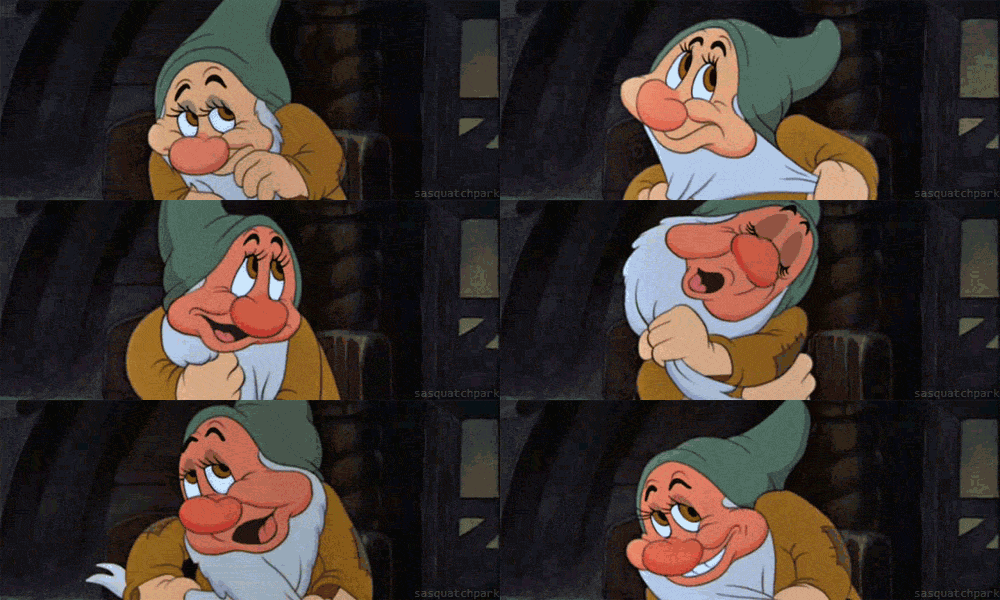
that thing about elves being able to grow beards just makes me imagine some how [ inset implausible thing here ] gimli being around when Legolas reaches his third life cycle…. he’d do it just to make gimli gawk at him

I imagine that Gimli would find it very distracting. 

HOT DAMN HUMMINA, ELF

(but Gimli’s own beard would still be the most magnificent, ofc
. oh my god. I sense even more competition in their future!!!)

Hi! I absolutley love Sansukh! I want to read it more than I want to read the actual books half the time. Everything about it kills me and I love it. I was just wondering, how did you come up with Legolas’s brothers? And um will we ever find out everyone’s dark names? (Especially the Ri Brothers and Dwalin cause I love all the dwarves but especially them and I think you already told us Kili’s so I don’t think I need to ask about him.)

Alaksjdfaljshdlasjdhfa THANK YOU SO MUCH NONNIE Oh my goodness, my face is scarlet. 

Ahhhh okay! Well, the idea behind Legolas’ brothers was born out of a half-formed idea from an earlier one-shot fic, From One Age to Another. When I was writing Chapter 16? I think it is? of Sansukh, all of a sudden there they were, nearly fully-formed. 

Plus, Legolas as a character is given some new dimensions when he is given more family members, because it gives him more relationships. And his brothers themselves roughly embody some possible Elven attitudes: Laindawar is aloof, disdainful and martial, a believer in Elven superiority of might. Laerophen is brilliant and learned and introverted, a (former!!!) believer in Elven superiority of intellect. There’s more to them than that, of course, and Legolas shares some of these beliefs at first. It has been interesting to play with how Thranduil’s own attitudes might have been adopted in different ways by THREE different offspring, rather than just the one. Resentment towards the other houses of the Elves, for example, or attitudes towards the other peoples of Middle-Earth. 

It also makes Legolas the youngest of three, and I personally like that dynamic for him. He has a lightness and a recklessness and a
 spontaneous gaiety in the books? If you know what I mean? He’s singing all the time, or making ridiculous pronouncements (”I go to find the sun!”) that feels less
 responsible? Staid and sober? Than a Crown Prince would seem. 

I feel like I am not putting this well!

I ALSO wanted a representative of the Wood-Elves at each place of battle, to be our Elven focal point. I consciously arranged it so that we would be able to see one of the sons of Thranduil in each location, their attitudes being challenged by whatever they confront. So, Laerophen at Erebor – the bookish, awkward outsider in a realm of Dwarves. Laindawar in Mirkwood – in his element, defending his home guerrilla-warfare style, but having to deal with pesky posh Galadhrim and a bloody Brown Wizard. And of course, Legolas at the epicentre of it all.

IDK, it happened and I ran with it! 🙂

Oh, dark names! I had fun with these! Yes, we have a list of them already! Here’s the list, and here’s the meanings of some of them! And here’s my dark-names tag for you!

(yep, I have done the whole Company, and so Dwalin’s name and the Ri Bros are there!)

Ooooh, what about elven aging?

Hey Nonnie!

Again, LOTS is known about Elves – Tolkien loved his Elves OH SO VERY MUCH, after all!

Here’s a good run-down on Elven aging and the life-cycle of an Elf 🙂

Summarised, though, it goes like this:

– Elves have a gestation period of around 1 year.

– They celebrate their conception day, rather than their birthday (which must raise awkward questions for their parents, I assume…)

– They look around 7 years old (compared to a human child) when they are in fact 20 years old.

– Their minds, however, develop VERY quickly. So, we’re talking childlike geniuses here, I suppose?

– Puberty is anywhere between 50-100.

– They have however reached adult height at 50, so I assume their puberty is mostly filling-out/broadening etc. 

– They’re an adult at 100. 

– They live forever, huzzah! Unless killed/heartbroken/silmarils. 

– They appear to have ‘cycles of life’ – it’s unclear what is meant by this, but it is said that in an Elf’s third cycle of life, they can grow a beard. (HEY CIRDAN, NICE FACIAL FUZZ)

Omg yeah the geography of M-E in the movies (LotR too) bothers me! Like in TTT Leggy says “The Uruks turn *north-east*!” Like you were chasing them from east to west and Isengard is not in north-east! (p.s. You can publish this publically, I don’t mind^^)

oh god yes that bit oh my godddd, Legolas. Isn’t there even a shot of them running into the sunset?! 

i think that it’s now pretty much taken as read by the fandom as a whole that the Elves of Mirkwood are one of the following: 

  1. permanently lost, 
  2. always facing the wrong way, 
  3. confused about these weird mortal compass-point names
  4. and/or terrible with directions

(It probably makes Thorin feel a little better about being directionally challenged, himself)

my fave option is 2 heheheh

Do you think dwarves or elves have the concept of surrogates? Like, say a dwarf decided to have relations with someone, but for whatever reason didn’t want to court anyone or marry. Then, perhaps said dwarf gets pregnant on accident. They don’t want to be a parent for whatever reason (since it’s not for everyone) but children are special to their race and so they wouldn’t take herbs or whatever to terminate the pregnancy. So, they decide to find a couple, or person, who wants children [1/2]

but for whatever reason is unable to have them. They’re still able to visit if they want to, like an open adoption type thing, but someone else raises the baby. Or what if elves or dwarves did figure out some way to do surrogacy similar to what’s done now, so that couples who want a baby that shares part of their genes are able to? [2/2]

Hey Nonnie!

God, I really don’t know. I think they would likely use surrogacy as well as adoption, but the particulars of this scenario are not something I know a lot about. I don’t think it would be very appropriate for me to speculate, either: I think this is something that people who have had life experience with surrogacy – either as a surrogate themselves, or as a child of a surrogate – would be in a better position to answer. 

actualmermaid:

Galadriel and Celeborn after Galadriel utterly wastes Dol Guldur and Khamul in chapter 40 of Sansukh by @determamfidd

IT WAS SO COOL. OH MY GOD.

She sighed soundlessly, and her eyes opened. No sign of the infinite white glow remained, only her usual starlit blue. “I am tired,” she managed, and then she lifted her hand to touch Celeborn’s cheek. “Ah, do not weep. This has cost me, but not nearly as much as we feared.”

I SHIP THEM SO HARD.

I used my own designs for them here, and I explain why Celeborn is see-through on my other drawing.

OH MY GOD

HOW MUCH DO I ADORE THESE DESIGNS, OH MY ACTUAL GOD, tHESE RE AMAZING 

I AM IN AWE

ahhh thank you thank you thank you SO MUCH, I am in complete LOVE WITH THEM OMFG…! POC Galadriel! Translucent Celeborn (THAT HEADCANON IS AMAZEBALLS BTW)! And alsdkhgfjashd so much love in their eyes, augh I cry :’)

psychopompious:

psychopompious:

psychopompious:

neverwondernever:

One of the things I like about Tolkien writing his series from the perspective of “its a translation from Westron” is that any time he uses ‘Christian’ speech (words like evil, dark v light motifs, demon–words that are specifically coded from what is a common view from Christian Europe) is that that doesn’t mean things were actual demons. He did what translators would do: write it to make sense to the people reading it. It also means that because we do not have the ‘original’ text (because it never existed except in his mind), we do not know what the proper words or descriptors are in Westron culture. We just know what the generic sense is, what its supposed to evoke.

This little part of his writing makes it so masterful. It means that we as fans are also given great freedom to read in between lines and fantasize as we like. It goes back to Tolkien’s comments on what fantasy is: fun. He provided us a translated text and it means we can create many variations from how we want to read the mysteries in between.

If one wanted to get even more meta about this, then there’s the fact that Tolkien suggested (repeatedly) that human languages had their basis in elven ones. According to his mythos, most humans first learned language and crafts from elves. And you can see this relationship continuing even into the later Ages, with human characters bearing the names of elves. Right up to “Ælfwine”, who supposedly transcribed much of the Silmarillion (and other assorted things) from Pengolodh, and whose name is a real life name which literally means “elf friend”.

So, what you have here is humans learning words and concepts from elves which they weren’t really equipped to understand. Because elves aren’t actually humans with pointed ears, they’re really quite alien, and experience the world in a completely different way. From the very beginning, you have humans basing their cultures around a fundamental misunderstanding, and this fundamental misunderstanding is transliterated and proliferated over thousands of years.

You could, technically, blame the very existence of most of the “Christian Europe coded” things on elves. Or rather, on humans who met elves and didn’t understand what the fuck they were saying but thought it sounded cool anyway.

I’m reblogging this with my own stupid tags because what’s the point of having a good tag rant if tumblr cuts it off:

talk to me about LaCE. and ‘sex’ and ‘marriage’ being literally the same word for elves. not necessarily because they were pro-abstinence puritans but. because elves are fucking telepathic. and that changes their perception of every goddamn social interaction period. and they bind inseparably. absolutely does not say they cant do this more than once. rather the opposite. also doesnt say that this happens the first time they have sex. or which kinds of sex acts cause bonding. does not say at all. but the very fact that this is a biological reality for them?. of *course* ‘sex’ and ‘marriage’ are the same concept to them??. it’s basically saying ‘we share ourselves utterly when we do this’. ‘because we’re telepaths’. ‘and sometimes that sharing becomes permanent and irrevocable’. but this is not a biological reality for humans. who misunderstand. because humans arent telepaths. they just misunderstand the elf concept of ‘marriage’. to mean that you SHOULD ONLY HAVE SEX AFTER MARRIAGE. AFTER A CEREMONY WHICH TO ELVES. IS PRACTICALLY MEANINGLESS??. i can just imagine an elf learning this and being like. ‘wait hold up back up a second’. ‘you guys seriously consider this ceremony’. ‘to be marriage’. ??? ??. ‘yeah how do you guys do it??’ says the human. ‘the ceremony is just a polite form of public recognition’ says the elf. ‘anyone who wanted to get married could just do that’. ‘but HOW’ says the human. ‘?? they marry?’ says the elf. ‘define marriage’ says the human. ‘the binding of two people together’ says elf. ‘okay that sounds the sa-’. ‘the physical act is a metaphor’ the elf continues. ‘oh’ says the human ‘i think i get it’ but DOES HE. DOES HE REALLY. =actual conversation between aelfwine and pengolodh at some point probably. as recorded in Laws and Customs Among the Eldar.

I’m reblogging this from myself yet again because it strikes me as an absolute TRAGEDY that no one has really mined this particular facet of canon for the wealth of cultural misunderstandings it offers, so I’m going to offer a few suggestions.

elf #1: I heard that humans actually marry in public, with spectators standing all around!
elf #2: oh, don’t be silly, they don’t marry like we do
elf #1: how do they procreate then?
elf #2: heavily ritualized but very brief skin contact, usually kissing
elf #1: that’s ridiculous
elf #2: it’s no more ridiculous than your theory!

human: hey friend, I wanted to invite you to be my best man!
elf: 
? your what?
human: my best man! I’m getting married!
elf: !!!
elf: are. are you propositioning me.
human: what
elf: what

human: by the way, I’m getting married
elf: that’s nice, love is a great and wonderful thing
human: oh, I don’t really love him, you understand how it is, he can provide for me and my family
elf: wait, what?? i thought you said you were getting married
human: ???
elf: i don’t think we’re talking about the same thing

a human scholar, ripping their hair out hundreds of years later: this text says this historical figure married THIS person, and that one says they married THAT person, and I have a dozen more like this saying this same elf was married to a dozen OTHER PEOPLE??
human readers, millennia later: why are there so many blank spaces in the family trees?? who the fuck are the parents

I find that a fun exercise to do while reading any of Tolkien’s works is to replace any mention of “marriage” or similar (when in reference to elves) with “they had sex”. Because, well, it’s exactly the same thing. More literally than usual. Also a fun exercise: Remembering that elves “sleep” (for a given definition of that word) with their eyes open, and then imagining Beren or Tuor settling in for post-coital snuggling only to find themselves stared at, unblinkingly, all night.

what are your head canons for thranduil’s wife?

Awww, thank you for asking! Spoilers under the cut:

I have named her ‘Aelir’ (”Birdsong”) and she was a Silvan Elf, not a Sinda. Her hair was very pale gold, rather than the Sindar white/silver. 

She was incredibly close to the trees, even more than is usual for Elves. She would have been the sort of Elf who began ‘waking up the Trees, teaching them to speak’ and walking with the Ents, had she been around in the Age of the Lamps, for example. 

She was tall and athletic, and never wore gowns or jewels except for a single necklace of white gems, a courting gift to her from her husband. She always wore green, and usually went barefoot, with grass-stains on her feet. Thranduil courted her for decades, fascinated by her strength and her freedom and her wisdom and her gentleness, all the joy she found in her home and in the things that grow. She was not a skilled and deadly warrior, as he was – but she was quite a wild thing nevertheless, forever clambering into the canopy of the trees like a squirrel, or flitting through the forest, constantly singing to the leaves and the sky. She hated the idea of being confined to formality and pomp (not unlike Bomfris, but of course Bomfris wouldn’t give two hoots about trees) – but in those days Thranduil was gentler and less chilly, and his tenderness and respect eventually won her over. She carefully unearthed his deep-buried heart as though it was one of her beloved trees, and she coaxed it back into bloom. They would dance amidst the leaves season after season, lost in the whispering of the wind. 

She loved completely, and fully – her husband, her children, her home. Her elder two boys were much like Thranduil in demeanor, dignified and reserved (though Laerophen gained her lanky height, and Laindawar had her lithe, squirrelish strength and her delight in the woods). However, her third child was most like her in spirit – in wide-eyed love with the world, singing constantly and heedlessly, sensitive to the green, slow unspoken world of growing things. (ALSO he managed to inherit her slightly obvious and oblivious manner!!)

As Thranduil became more and more involved in trying to keep his Kingdom free from the taint of the growing darkness, he missed the first signs in his wild Silvan wife. By the middle of the Third Age, Aelir had sickened greatly, practically reflecting the sickness creeping through the wood, and it was too late for any healer to halt its progression. The only cure was to go over the sea, to Valinor, where healing would come. 

But once there, there is no coming back. No ship comes East through the mists.

It was an awful time. For all of them. And yet another loss for Thranduil to endure, surrounding his heart in yet another layer of ice. All he has left, he clings to all the more tightly.Â