Got a quick screen grab so you could see what I was talking about.
WHAT IS THIS NONSENSE. WHOEVER MADE THAT NEEDS TO FIGHT ME
honestly this mindset hurts kids who love the arts so much.
imagine constantly fighting high school councilors just to get into the one class that keeps you alive. imagine constantly lying to teachers about what you plan on majoring so you don’t get “the talk” imagine no one you love believing in you, and constantly asking what your “back up plan” is. imagine being kind of miserable at your own graduation and grad party because people are always asking you about your future, and when you tell them they just look at you like your stupid.
imagine constantly being told that what you do isn’t good enough. that you’ll never succeed without changing who you are.
imagine having to try to stop yourself from flat out breaking down and sobbing in front of your professor after your first lesson, because they simply told you “you know what? I think you can do this. If you work hard I think you can be very successful in this field.”
because that’s the first time anyone’s actually believed in you.
yeah, science is great, but putting it above the arts is one of the biggest mistakes this society has ever made.
^^^^^ This is really well put. ^^^^^
In addition to all the other good points on this, I want to point out that Wells Fargo would have had to pay a graphic designer to create this. How can they say the arts are impractical and unnecessary while they are paying someone for their design skills?
and they have a lot of gall to say that considering the work of visual artists is literally everywhere in research labs
from educational posters
to textbook figures
to even the packaging art and design of the reagents we use
so as a scientist i just want to say: without the hard work and expertise of artists, research science, for one, would not be as productive. so thank you. your skills are valuable and you are needed.
and look, science may keep us along longer and make our lives more productive but what is the point if we can’t also do things like watch shows and movies and go to museums and dance performances and listen to music?? STEM is like the flat outline of a drawing. yeah, you can tell what it looks like, and i guess it could function on its own; but the things like humanities and literature and art fill it with color, and shading, and emotion. so much more beautiful, so much more fulfilling right? they make the life that STEM helps improve worth living.
so i’ll be the scientist bc that’s what i’m good at and what i like to do, and you be the dancer, the actor, the artist, the historian, the poet, ok? and together we’ll both make the world a better place 🙂
And honestly – pursue both. But if you’re paying for a degree, may I suggest that you buy the degree in science and supplement it with add-on minor degrees/modules/hobbies/certificates/expertise in:
Science + performing arts = so now you are an incredibly desirable person, science communicator, teacher, lecturer, demonstrator, media officer, festival performer, comedian, workshop leader, person who is paid to teach these skills to scientists, person who is trained to talk to the media; people throw themselves at your feet, basically you’re primed for a position as a television science presenter (and you just might make it), but you combine skills of performance/charisma with “actually has interesting stuff to talk about” in ways that make you fascinating and successful; if you go into entertainment the marketing writes itself; and if you stay in science/academia you’re damn good at wooing panels, winning grants, convincing people to buy you new labs, and enchanting lecture halls full of hundreds of students; if you stay in both you are part of the scicomm scene and have a tribe of bloodsworn siblings; you are an Outreach Person now;
Science + writing = you’re the popular person who writes the research papers and picks up pocket money editing theses and cover letters. You can sell science writing for money and are extremely good at composing arguments. your English credentials earn themselves back really quickly. There are many, many jobs that want you, and will treat you like a magical beautiful unicorn treasure. Nothing’s stopping you from writing a novel, but in the meantime, you’re doing very important work and always have more fascinating material than you can possibly compile,
Science + fiction = this is a genre, apparently,
Science + poetry = this is a startlingly common combination and was basically a requirement for being a Victorian scientist (and even earlier, before scientific writing became its own thing, books on science were sometimes written as poetry.) Nature, often noted as the most influential and high-impact scientific journal on the planet, used to publish quite a lot poetry in the journal (and still publishes flashes of science fiction on the back page!)
“The ideal scientist thinks like a poet and works like a bookkeeper,” EO Wilson says, and sometimes the poems get written down. There are entire anthologies entirely composed by scientist poets, and some beautiful stuff lands in my inbox every day. Science and nature are some of the most common themes in poetry, to everyone’s benefit:
Though my soul may set in darkness, it will rise in perfect light; I have loved the stars too truly to be fearful of the night.
Science + audiovisual/photoshop skills = you do all the figures for the papers and posters, are hired to illustrate textbooks and are a consultant, people think you are magical, perhaps you are a wildlife photographer or videographer, or you can help design items and goods for the museum you work for, or show off your research department to best advantage with some really good posters, hurray;
Science + fine art = the advertising writes itself, your art shows are well-attended and successful; everyone showers you with compliments and buys your work, people find you weirdly fascinating, pieces get written about you in the news, you are never short of subject matter for your art, you also make reasonable income/influence by illustrating papers and textbooks, your presentations are always A+ aesthetic, you never run out of material or ideas,
Science + music = somebody needs to make music for nerds. But even if you don’t make your music about science, there are plenty of professional scientists who do music as a hobby/second income/second career. Off the top of my head I know a cancer biologist who is a concert harpist, planetary scientist in an acclaimed folk-pop band, a biologist opera singer, a paleontologist who busks, and an all-scientist jazz band. This is a surprisingly common and successful balance. They’re frequently successful scientists (and quite secure with work/life balance) as well as successful musicians (many go on to sign record contracts etc, but again, they’re renowned for being practical and balanced.) There are SO MANY scientist-musicians that this article talks about professional scientists who science their music (and then go on to make music about the science of their music).
Science + history = okay this is literally an entire meta-discipline? and can range anywhere from the entire field of anthropology to the field that is literally called science history. It also includes some of those blurry science/humanities fields like archaeology, which vary on whether they are Science or Art, usually depending on how “easy” they are perceived to be and how many women influence the field. “Easy” plus the presence of women = the field is considered an art. Perceived difficulty plus the presence of men = the field is a science.
ARE YOU REALLY, INDIANA? I THOUGHT YOU WERE A PROFESSOR OF ANCIENT HISTORY WITH A NAUGHTY HABIT OF STEALING ARTIFACTS. I have some issues with your scientific methods, Sir
Science + programming = THE MOST USEFUL PERSON ON THE PLANET, seriously, if you acquire a proven science background and get yourself up to scratch with coding YOU ARE A DEMIGOD,
Science + visual storytelling = your webcomic is beloved even if you can
only draw stick figures (XKCD). You can go adorably pastel (Bird and
Moon) or sarcastic slice of life (PhD Comics) but your stuff is going to
have a lot of appeal and you will never run out of subject matter. Journals
are now suggesting that research could be published in comic form,
there is definitely a place to tie this back to harder science. Or if
you don’t really want to get into that, you can just be popular on
social media.
Science + craft = there are a surprising amount of things to do with this, but a reasonable market lies in making science-themed gifts and items to sell. The popularity of molecule necklaces and virus plushies is due to scientists showing up with craft skills, and people can’t wait to buy it. Everything from knitting patterns to 3D printing mockups to exquisite sculptures of Dunkleosteus to funky clothing and design has a perfect niche market that can’t wait to buy what you’re selling – and you’re apparently one of the few people on earth that can put these ideas together! And you have SO MANY OF THEM!
But, you know, everyone, PLEASE keep perpetuating this concept of a vast and unknowable gulf between science and the arts. PLEASE? Because it makes those of us who bridge the nonexistent gap seem incredibly impressive.
Stronger together, people.
My college, which is focused on environmental science and engineering, is actively trying to coax our students to get more involved in the arts. Those are the skills that will put our students at the next level compared to their fellow graduates who will be competing for the same jobs, and they are the skills that STEM as a whole desperately needs in order to be able to move forward and be of service to society. As much as STEM is getting pushed as a career path, culturally we’re experiencing some massive problems due to the inability of people in the STEM fields to be able to communicate with the rest of the populace and gain their support, trust and ideally their understanding. See: anti-vaxxers, climate denial, funding cuts to education, NIH, NSF, etc. (Because why the hell would we need studies that tell us whether antibacterial soaps increase the chance of liver cancer and frivolous crap like that?)
So it turns out this is in fact a serious issue that poses a danger to society.
And I personally am annoyed by this ad because do you know how hard it is to convince science kids that they need to pay attention to the arts in order to do their jobs well? Turns out it’s pretty damn hard, thanks to the narrative these ads are perpetuating.
*highfives* I am so dang happy I was a part of that. Heck, I managed to keep my cool and hold my ground against a very down-the-rabbit-hole anti-vaxxer today. Hells to the fucking yeah, Nonnie, gimme a Go Science high-five!!
Fun fact: Gender and Sex are both human made constructs designed to describe natural phenomenon but are not actually based in any biological reality. Much like the concept of “species”, it’s a model, and no model is an actuality – then it would not be a model, it would be a fact.
In truth sexual characteristics are diverse and varied and do not always match up with sex chromosomes; also, a sexual “binary” of sorts is not constant amongst all living things, and most organisms have other systems of reproduction.
Furthermore, gender is the suite of societally-defined social roles and behavioral characteristics that is typically assigned based on the externally perceived sex of a child; and does not actually have anything to do with biology – even less so than sex. Even though it is assigned based on this externally perceived sex, a person’s gender does not have to remain with the one assigned; much as we don’t determine people’s careers based on who their parents were anymore, your birth has no limitation on who you are and what gender identity you construct for yourself. Since it is a societally defined construct, people can and do construct more than the two traditional ones, and all are valid.
Just because you cannot handle your societally constructed worldview surrounding sex, gender, and genetics being dismantled by sociology & biology itself doesn’t mean, additionally, that you have the right to make other people feel unsafe and uncomfortable – in short, that you have the right to remove people from moral consideration – simply because you don’t like having your world view being dismantled. Believe it or not, the complexities of human behavior & the diversity of sex and reproduction in life cannot all be covered in a simple high school biology class.
So next time you want to say “didn’t you pass biology” remember: a biology PhD student, who graduated from the University of Notre Dame with an actual degree in Biological Sciences, has reminded you that you’re wrong.
There are more than two genders.
The end.
Sex is biological tough… It’s not a social construct… It’s not time, racism etc. It’s a physics attribute.
Why are you trying to argue with someone who said species is a constructed model and not a fact? You’re not going to change someone’s mind when they’re that far down the rabbit hole
Me: Spends 6 years intensely studying biological science and evolution at two major universities with widespread academic acclaim, earning honors and high GPAs and am currently working on a PhD in the subject of biodiversity and evolution
You: Somehow thinks they know more because you took a couple of classes
Lol
…Buddy. Buddy. Dude. I really don’t think you want to open this can of worms.
I mean, I know that in school they teach you a very clean, concise, definitive way of doing things and you’ve probably learnt something like the definition of a species is a population of organisms that are able to reproduce and produce viable offspring, or something. But I mean literally anyone who has done even undergrad biology can tell you that that statement is incredibly reductive and incredibly controversial in the scientific community [1][2]. In fact, you probably don’t even need a background in biology to spot the obvious flaw in the logic there, which is the fact that organisms classified as different species do reproduce and produce viable offspring. Quite a lot, actually. Lions and tigers (Panthera leo and P. tigris), coyotes and grey wolves (Canis latrans and C. lupus)… In fact, there’s even a word for new species arising through hybridisation between existing species – hybrid speciation [3]. The great skua (Stercorarius skua) is believed to be an example of this in animals [4], and another interesting one that may be pretty much hybrid speciation in action (though not nearly anything that can be called a new distinct species yet) is the so-called “Eastern coyote”, a population of wild coyotes in the eastern US that are mixed with grey wolf and domestic dog, and can contain as much as 40% non-coyote DNA [5].
And, in fact, the ability of two organisms to reproduce and produce viable offspring actually has very little with how we choose to classify them, because evolutionary and genetic relationships are rarely that simple. For example, some species that are the same genus – e.g. horses (Equus ferus) and donkeys (Equus africanus) can interbreed, but their offspring are usually sterile [6], while other species that are different genera to each other can interbreed to produce intergeneric hybrids, some of which are even fertile (for example crosses between false killer whales (Pseudorca crassidens) and bottlenose dolphins (Tursiops truncatus) [7], or between king snakes (genus Lampropeltis) and corn snakes (genus Pantherophis) [8]). Most “exotic” domestic cat breeds (e.g. Bengals and Savannahs) also fall into this category – for some reason felids are genetically Weird in that a wide variety of species in the family Felidae seem able to interbreed with each other, no matter how different or distantly related they are. I mean…
Look at this shit. Now bear in mind that the domestic cat (Felis catus) is known to be able to interbreed with species in the caracal, ocelot, lynx and leopard cat lineages in addition to those in its own lineage, and if that wasn’t bad enough puma/leopard hybrids are a thing that exist. Those species aren’t even in the same subfamily, let alone genus or genetic lineage – the leopard is classed as subfamily Pantherinae, genus Panthera (P. pardus) while the puma is classed as subfamily Felinae, genus Puma (P. concolor).
Although these aren’t even the most distantly related species that are able to interbreed – domestic chickens (Gallus gallus domesticus) are known to hybridise with guineafowl [10], and the offspring of these crosses are interfamilial hybrids since chickens and guineafowl are classified in different families (chickens belong to family Phasianidae, guineafowl to family Numididae).
And of course another place where the “able to interbreed and produce viable offspring” definition falls apart is with organisms that reproduce asexually or without the need for a sexual partner, which is even more complicated when you consider that some species (for example, some species in the paraphyletic whiptail lizard genus Cnemidophorus) aredioecious, meaning they have separate sexes, and reproduce by producing gametes via meiosis, but have actually lost the ability to reproduce sexually somewhere along the evolutionary line – these species reproduce predominantly or entirely by parthenogenesis (essentially a form of self-cloning) and the Y chromosome has been entirely lost in the population. This also ties into hybrid speciation because it is believed that these parthenogenic species arose from hybridisation between two or three sexual species [11][12], leading to polyploid individuals (i.e. those with ‘extra’ sets of chromosomes) – for example, the all-female parthenogenic species Cnemidophorus neomexicanus is actually a hybrid of two sexual species, Cnemidophorus inornatus and C. marmoratus (or C. tigris, according to Wikipedia), and thus new individuals of this species can be formed either by parthenogenesis in a single C. neomexicanus parent, or sexual reproduction between a male and female C. inornatus and C. marmoratus/C. tigris [13]. Some female parthenogenic species are also able to interbreed sexually with males from sexual species, resulting in hybrids which may or may not also be parthenogenic [14].
So you can ask, well what the fuck is a genus, or a species for that matter, if it doesn’t necessarily indicate whether two animals are genetically similar enough to interbreed or not? And, more to the point, is there a strict set of quantitative criteria that defines whether two populations of organisms are classified as the same or different species? And I mentioned speciation, which brings up the question, when exactly in the process of evolution does one species actually become another?
The thing is, there aren’t actually definitive answers to these questions – if you ask a bunch of biologists what a species is, it’s likely you’ll get different answers. “Species” also has a number of definitions [15][16], mainly depending on the type of organism being studied and the angle it is being studied from. For bacteria, for instance – where “similar enough to reproduce” really isn’t applicable – I think the general consensus is that individuals are grouped together if their genetic similarity to one another is 97-98% or higher, while a similar definition of “organisms that are highly genetically similar to one another” tends to be used for asexually reproducing organisms such as some plants, and parthenogenic animals like whiptail lizards or Bdelloid rotifers (which does of course raise the question of what exactly “highly similar” means – any decided-upon cutoff point will necessarily be somewhat arbitrary). Such groupings of organisms may be referred to as phylotypes to distinguish them from the reproductive definition of a “species” [17]. Likewise, a lot of ecological writing will define species and speciation according to reproductive isolation, which isn’t necessarily synonymous with reproductive compatibility – reproductively isolated populations may be genetically able to reproduce, but be prevented from doing so or unlikely to do naturally so due to differences in geographical location, habitat or behaviour (think lions and tigers). These are some of the many different “types” of species, with either competing or overlapping definitions of what exactly constitutes a species in each case:
Morphological or typological species (morphospecies)
Phylogenetic species
Evolutionary species
Genetic species
Genalogical concordance species
Reproductive species
Autapomorphic species
Ecological species
Recognition species
Phenetic species
Isolation species
Cohesion species
…You get the idea.
For vertebrates, I think generally the two most used definitions are the biological species concept (BSC) and phylogenetic or cladistic species concept (PSC), which differ in their criteria for what they consider a species [18][19]. PSC, for example, doesn’t include a subspecies category while BSC does – and thus, some organisms that are classified as subspecies of the same species under BSC are either classified as different species or are lumped together as the same species under PSC. For example, grey wolves and domestic dogs. The domestic dog is/was often considered a separate species to the grey wolf, for obvious (morphological/behavioural) reasons – the wolf was Canis lupus, the dog C. familiaris – but since dogs are descended from wolves (a now-extinct lineage of wolves, not modern grey wolves [20], but Canis lupus nonetheless) they are more properly classified as a subspecies, C. l. familiaris. Likewise, having also ultimately descended from wolves, the dingo is officially classified as C. l. dingo, although there is some debate about that – at one stage I remember it being classified as a “subspecies” of domestic dog, Canis lupus familiaris dingo (and it’s still, to my knowledge, widely considered to be descended from domestic dogs [21][22], in which case the second name would be more correct), while still other people classify it as a completely separate species, Canis dingo [23]. You can see why species boundaries and definitions can get murky, especially when the exact evolutionary origins of a particular animal are unknown or hotly contested.
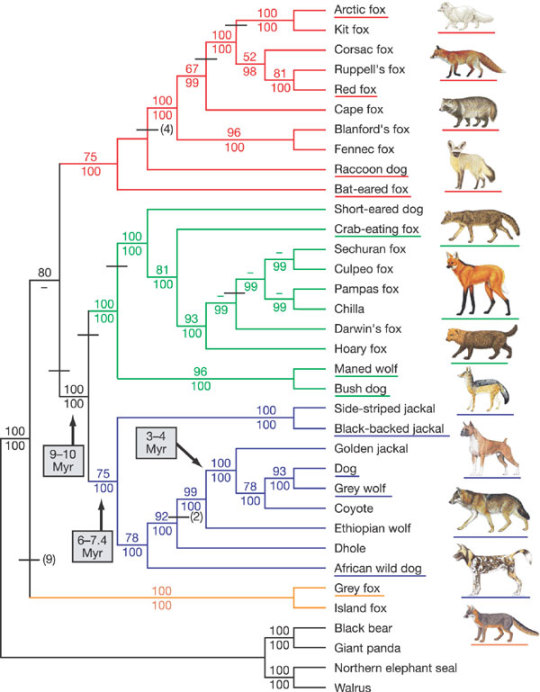
In fact, canids as a whole are kind of a mess when it comes to phylogeny. How many species of wolf there are really depends on who you ask – some populations traditionally classified as subspecies of the grey wolf, for example the Indian wolf (traditionally C. l. pallipes), the Himalayan or Tibetan wolf (traditionally C. l. chanco) and the Eastern wolf (traditionally C. l. lycaon) have been suggested instead to be classified as separate species – Canis indica, Canis himalayensis and Canis lycaon, respectively [24][25]. Likewise, just last year it was discovered that what was thought to be an African subspecies of the golden jackal (Canis aureus) had in fact been misidentified and was instead an undiscovered species of wolf, now the African golden wolf (Canis anthus) [26]. And then there’s also the fact that, despite being called “jackals”, the black-backed and side-striped jackals actually aren’t very closely related to the golden jackal, or indeed to any of the rest of the genus Canis [27]. In fact, going by the cladogram below, you can see that the African wild dog and dhole – both of which are classed in their own, unique genera (Lycaon and Cuon, respectively) – are actually placed closer to wolves, golden jackals and coyotes than black-backed and side-striped jackals are, even though both of the latter species are considered part of genus Canis (the black-backed jackal is C. mesomelas and the side-striped is C. adustus). Many sources also say that these two species differ from the rest of the group in that they have only 74 chromosomes, while wolves, coyotes, golden jackals, African wild dogs and dholes all have 78. This makes the moniker of genus Canis somewhat useless when trying to determine exactly how genetically similar these animals actually are to one another.
And this isn’t even touching the issue of the “red wolf” (Canis rufus), a critically endangered so-called “species” of wolf closely related to the grey wolf, eastern wolf and coyote, which more recent molecular and genetic analysis has revealed may simply be a wolf/coyote hybrid [29]. Of course these classifications aren’t set in stone, either – new studies and discoveries are constantly uprooting and rewriting our knowledge of phylogenetic and evolutionary relationships among species. Sometimes it’s also pretty much impossible to accurately represent the relationships between similar-but-distinct populations using only the terms “genus” and “species”, which is where alternate concepts like species complex, subgenus and superspecies come in.
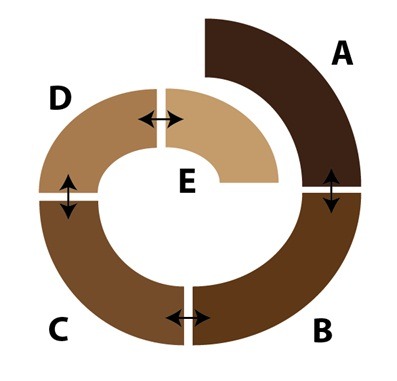
Another feature of evolution and speciation that makes classification difficult is what are known as ring species, in which a series of neighbouring populations of organisms may evolve divergently (i.e. undergo allopatric speciation) in such a way that each geographically adjacent or overlapping population can interbreed with the next, but the last population in the “ring” has diverged to the point that it can no longer interbreed with the first (basically, population A can interbreed with population B, B with C and C with D, but D can no longer interbreed with A).
When does the actual split occur, and at what point in the ring can we consider the populations to be different species? We just don’t know. (And in some cases this is considerably more messy and complicated than even the ring species model makes it seem [32]). The point is, though, that there is no definitive, universally agreed-upon cutoff point at which we can say with certainty that two organisms have evolved sufficiently as to become different species, any more than you can definitively say where along a rainbow spectrum of colours red becomes orange or orange becomes yellow. The decision whether to lump or split taxa becomes even more arbitrary in paleontology than it is with extant species [33][34] – when you’re working with an incomplete fossil record and pretty much going entirely on morphological similarities since genetic or molecular analysis often isn’t possible, there isn’t really a way to conclusively determine whether that specimen you found represents a new species, a new genus, or is simply a larger/smaller/juvenile/unfortunate-looking version of an already-described animal. Many specimens now believed to be juveniles of previously-described species were originally believed to be completely new ones – for example, Nanotyrannus is now often (but not universally) agreed to be a juvenile Tyrannosaurus rex [35], and Dracorex and Stygimoloch are considered immature specimens of Pachycephalosaurus [36]. And then there was the whole deal where Brontosaurus didn’t exist for a while and then it did again and it was all very confusing [37].
Obviously, at the end of the day, a zebra is materially different from a dog in the same way that, to get back to the original topic, a penis is materially different from a vagina (actually a bad analogy since homologous reproductive organs are much more similar to each other than taxa that have been separated for millions of years, but anyway). The biological differences and similarities themselves exist, but any attempt to categorise and quantify them will necessarily rely on socially constructed and frequently arbitrary models, definitions and assumptions. That’s basically what science is – a continuous (and frequently wildly inaccurate) attempt to try to make sense of reality. We often attempt to understand or make predictions about reality using mathematical or quantitative models of the situation or by sorting things into sets and categories, which is useful and necessary in many cases but is also often far too simplistic to be taken as any kind of gospel truth regarding the actual nature of reality, because simply put reality doesn’t care for or abide by human-made rules and categories. Essentially, we’re trying to find quantitative ways to represent things that are by nature qualitative, and that’s always going to be arbitrary to some extent. Obviously biological characteristics (whether genetic, sexual/reproductive, etc.) objectively exist and would continue to exist if humans and human culture were to suddenly disappear, and in that sense, things like sex, gender and taxonomic classification can be said to be basedin biological reality. But human attempts to define or categorise these characteristics – for example species concepts, the binary model of sex, etc. – are not in themselves biological realities, and are subject to change based on new information. For example, evolutionarily speaking, “reptiles” (as we traditionally understand them) don’t exist [38]. Obviously this doesn’t mean that lizards, tortoises, snakes, crocodiles, non-avian dinosaurs etc. don’t exist or never existed. It simply means that the socially constructed classification of animals into two distinct, mutually exclusive groups called “reptiles” and “birds” is completely arbitrary and not actually the result of any inherent biological reality (in fact the opposite).
I mean I know how crappy the highschool biology syllabus can be @valarie-lynn so I’ll also link you to the Wikipedia page on species and the species problem, and also to somemoreonsex and how it’s just as complicated and arbitrary as the concept of species (from Actual Biologists™) if you’re interested. I’ll also leave you with a quote from Charles Darwin:
“From these remarks it will be seen that I look at the term species as one arbitrarily given for the sake of convenience to a set of individuals closely resembling each other, and that it does not essentially differ from the word variety, which is given to less distinct and more fluctuating forms. The term variety, again, in comparison with mere individual differences, is also applied arbitrarily, and for convenience sake
Hello, my name is Poetry, and I love social insects. Whether they’re ants, bees, termites, wasps, aphids, thrips, or ambrosia beetles, I find them fascinating to learn about. But if the sci-fi books I read as a kid had had their way, I should have run screaming from every ant colony I saw.
From the buggers in Ender’s Game to the Borg in Star Trek to the Vord in Codex Alera to ants and termites themselves from a morph’s-eye view in Animorphs, social insects, and the aliens or artificial intelligences that closely resemble them, are portrayed as “hive minds” with an emotional tone of existential terror. And I’m here to tell you that these portrayals are totally unfair.
What they get right
Here are some features that most portrayals of social insects and their analogues in sci-fi get right. Yes, social insect colonies have queens that are primarily responsible for reproduction. Yes, social insects have very different sensory modalities from ours. We primarily use sight and sound to communicate and navigate the world, while social insects use taste and smell and vibration. Yes, social insects have specialized division of labor to particular tasks, and yes, they are willing to sacrifice themselves in droves to protect the colony. And sometimes, they will enslave social insects from other colonies or even species to serve their own ends (x).
Thus ends what sci-fi portrayals get right.
What they get wrong: Queens
Almost universally in sci-fi, when you kill the queen, the hive disintegrates into chaos. You’ve cut off the head! The central intelligence of the hive is gone! They’re just mindless borg-units with no idea what to do!
Indeed, in some social insects, such as leafcutter ants, if you kill the queen, the whole colony will die – but probably not for the reasons you think. However, it’s more common for social insects to be able to carry on just fine regardless. In most ants and bees, there are “backup” queens that are reared up by the workers in case the current queen should die. And in many social insects, a worker can step up and become a queen in her place. (Hilariously, a worker ant that steps up to reproduce in place of a queen ant is called a gamergate.)
But here is the most important problem with the sci-fi trope of killing the queen to kill the hive. The queen is not the brain of the hive. She is the ovary.
If you think of a social insect colony as a superorganism, which it’s useful to do in many cases, different groups of insects within the colony act like organs. One caste protects the colony from invaders, which is like an immune system. One caste scouts for new places to forage, which is like a sensory system. Generally, science fiction has a good grip on this idea. Where sci-fi authors fail is that they think the queen is the brain of this superorganism. She is not. She is the reproductive system. The queen does not control what happens in the hive any more than your reproductive system controls what happens in your body. (Which is to say, she has some influence, but she is not the brains of the operation.)
The reason why leafcutter ant colonies die when the queen dies is because the colony has been castrated, not beheaded. Most animals die when they are no longer able to reproduce, even if their brains are still perfectly functional. For castrated colonies with no backup queen or gamergate and no hope of getting one, there is no point in carrying on. Their evolutionary line has ended.
What they get wrong: Swarm intelligence
Here is how social insect hive minds work in science fiction: the queen does the thinking, and the rest of the hive goes along with whatever she thinks.
Now, I’ve already told you that the queen is not the brain of the hive. So where is the brain? Well, that is exactly the point of swarm intelligence. The brain does not reside in one particular animal. It’s an emergent property of many animals working together. A colony is not like your body, where your brain sends an impulse to your mouth telling it to move, and it moves. It’s more like when two big groups of people are walking toward each other, and they spontaneously organize themselves into lanes so no one has a collision (x). There’s no leader telling them to do that, but they do it anyway.
Much of the efficiency of social insect colonies comes from very simple behavioral rules (x). Hymenopterans, the group of insects that includes ants, bees, and wasps, have a behavioral rule: work on a task until it is completed, and when it is done, switch to a different task. If you force solitary bees (yes, most bee species are solitary) to live together, they will automatically arrange themselves into castes, because when one bee sees another bee doing a task like building the nest, its behavioral rule tells it that the task is completed and it needs to switch to a different task, like looking for food.
Individually, a social insect isn’t all that smart, whether it’s a queen, worker, soldier, or drone. But collectively, social insects can do incredibly smart things, like find the most efficient route from the colony to some food (x), or choose the perfect spot to build their hive (x).
What they get wrong: Individuality
The existential terror of the hive mind in science fiction comes from the loss of the self. The idea is that in a social insect colony, there is no individual, but one whole, united to one purpose. No dissent, disagreement, or conflicting interests occur, just total lockstep. I totally get why that’s scary.
The thing is, it’s just not true of real social insects. There is conflict within colonies all the time, up to and including civil war.
A common source of conflict within colonies is worker reproduction. Yes, in most social insects, workers can in fact reproduce, though usually they can only produce males. So why don’t they? Because it’s not in the interest of their fellow workers. Workers are more closely related to their siblings and half-siblings produced by the queen than they are to their nephews, so they pass on more of their genes if they spend resources on raising the queen’s eggs. So, if a worker catches its fellow laying an egg, it will eat the egg. Not exactly “all for one and one for all,” is it?
Worker insects may also fight in wars of succession. If there is more than one queen in a species where queens do not tolerate each other (yes, there are species where multiple queens get along together just fine), such as monogynous fire ants, the workers will ally themselves with one queen or another and engage in very deadly civil war.
Finally, in some species, the queen needs to bully the workers into doing their jobs, and the dominant workers need to bully subordinate workers into doing their jobs (x). Yes, sometimes workers try to laze around and mooch.
Surprisingly human
Here’s what I find weird about depictions of social insects in science fiction. They are portrayed as utterly alien, Other, and horrifying. Yet humans and social insects are very, very similar. The famous sociobiologists E.O. Wilson and Bernard Crespi have both described humans as chimpanzees that took on the lifestyle of ants.
I think what fascinates people, including me, about ants, bees, and their ilk is that you watch, say, a hundred ants working together to tear up a leaf into tiny bits and carry it back to their colony, or a hundred bees all appearing out of seemingly nowhere to sacrifice themselves en masse to stop a bear from eating their hive, and it looks like magic. It really does look like some kind of overmind is controlling their collective actions.
But imagine you’re an alien who comes to Earth, and you know nothing about humans or the way we communicate. Wouldn’t we look exactly the same to them as ants and bees look to us? Wouldn’t they look at us sacrificing our lives by the thousands in wars, or working together to build cities from nothing, and think, Wow, how do they coordinate themselves in such huge numbers, why do they give up their lives to defend their borderlines, I guess there must be some kind of mega-brain they all share that tells them what to do, and they just march in lockstep and do it.
If there’s anything I’ve learned from the study of both social insects and humans, it’s that any system that looks monolithic and simple from a distance is in fact fractured, messy, and complicated when you look at it up close.
Social insects aren’t scary mindless robot-aliens. They’re a lot like you and me. As much as I was terrified as a kid by the Animorphs book where an ant morphs into Cassie and screams in pure existential horror at its sudden individuality, I actually think an ant would adjust very easily to being a human, and that a human would adjust very easily to being an ant – much more easily, in fact, than humans adjusted to morphing, say, sharks, in the very same book series.
Everyone knows that shooting stars are just meteors entering the atmosphere, right? If you didn’t, congratulations you just failed the fourth grade. What some people don’t know, however, is that real shooting stars exist as well; they’re called hypervelocity stars. These are big, fiery balls of gas rocketing through space at millions of miles per hour.When a binary star system is gobbled down by the supermassive black hole at the center of a galaxy, one of the two partners is consumed, while the other is ejected at high speed. Just try to imagine a huge ball of gas, four times the size of our sun, hurtling out from our galaxy at millions of miles per hour.
9. The Planet From Hell
Gliese 581 c wants to kill you. This planet orbits a red dwarf star, many times smaller than our Sun, with a luminosity of only 1.3% of our sun. This means that the planet is far closer to its star than we are to ours. Because of this, it is stuck in a state of tidal locking, meaning that one side of the planet is always facing the star, and one side is always facing away, just like our moon’s relationship with Earth.The tidal locking of the planet alone results in some pretty odd features. Stepping out onto the star-side of the planet would immediately melt your face off, whereas standing on the opposite side of the planet, where there is no sun, would freeze you instantly. However, in between these two extremes is a small belt where life could theoretically exist.
8. The Castor System
As if one or two giant, fiery balls of gas weren’t enough, here we have the Castor System. As one of the two bright stars from the Gemini constellation in our night sky, it has some serious luminosity. This is because the Castor System isn’t one, or two, but six stars, all orbiting around a common central mass.Three binary star systems orbit each other here, with two hot and bright A-Type stars being stuck in the system, as well as four M-type red dwarves. All together, though, these six stars put out roughly 52.4 times more luminosity than that of our sun.
7. Space Raspberries and Rum
For the last few years, scientists have been studying a dust cloud near the center of our Milky Way galaxy. If there’s a God out there, it seems that he decided to get creative—this dust cloud, named Sagittarius B2, smells of rum and tastes like raspberries.The gas cloud in question consists largely of ethyl formate, which is known to give raspberries their taste, and rum its distinctive smell. This large cloud is said to contain a billion, billion, billion liters of the stuff—which would be great, if it wasn’t rendered undrinkable by pesky particles like propyl cyanide.The creation and distribution of these more complex molecules is still a mystery to scientists, however, so we won’t be opening up an intergalactic pub anytime soon.
6. A Planet of Burning Ice
Do you remember Gliese? That hell-hole of a star that we talked about earlier? We’re heading back to the same solar system for this one. As if one murderous planet wasn’t enough, Gliese supports a planet made almost entirely out of ice, that’s at 439 degrees Celsius. Gliese 436 b is, quite simply, a burning ice cube. Imagine Hoth from Star Wars, except that it’s on fire. The only reason this ice stays solid is because of the huge amount of water present on the planet; the gravity pulls it all in towards the core, keeping the water molecules so densely packed that they cannot evaporate.
5. The Diamond Planet
55 Cancri e is made entirely out of crystallized diamond, which would would be priced at 26.9 nonillion dollars (A nonillion is a 1 followed by 30 zeros).The huge diamond planet was once a star in a binary system, until its partner began to cannibalize it. However, the star was not able to pull its carbon core away, and carbon is just a ton of heat and pressure away from being a diamond, so at a surface temperature of 1648 degrees Celsius, the conditions are almost perfect. One third of the mass of the planet is said to be pure diamond, and whereas Earth is covered in water and abundant in oxygen, this planet is made mainly of graphite, diamond, and a few other silicates.
4. The Himiko Cloud
If there has ever been any object that has shown us the origins of a primordial galaxy, this is it. The Himiko Cloud is the most massive object ever found in the early universe, and it dates to only 800 million years after the Big Bang. The Himiko Cloud astounds scientists with its sheer size, roughly half that of our Milky Way Galaxy. Himiko belongs to what is known as the “reionization epoch,” or the period from around 200 million to one billion years after the Big Bang, and it’s the first glimpse scientists have managed to get of the early formation of galaxies.
3. The Universe’s Largest Water Reservoir
Twelve billion light years away, the universe’s largest water reservoir resides in the heart of a quasar. Containing 140 trillion times the amount of water in Earth’s oceans, and found near the colossal black hole at the center of the quasar, the water unfortunately manifests itself in the form of a massive cloud of gas, several hundred light years in diameter.
2. The Universe’s Largest Electrical Current
Only a few years ago, scientists stumbled upon an electrical current of cosmic proportions: 10^18 amps, or roughly one trillion lightning bolts. The lightning is thought to originate from an enormous black hole in the center of the galaxy, which has a core that is supposedly a “huge cosmic jet.” Apparently, the black hole’s huge magnetic field allows it to fire up this lightning bolt through gas and dust to a distance of over one hundred and fifty thousand light years away. And we thought that our galaxy was big, this single lightning bolt is one and a half times the size of it.
1. The LQG
This structure, my friends, is the Large Quasar Group. Our galaxy, the Milky Way, is only one hundred thousand light years across. Think about that for a moment; if something happens on the far side of the galaxy, it would take a hundred thousand years for the light to reach the opposite end. That means that when we watch an event take place at the other end of our galaxy, it actually occurred when the human species was just beginning to form. Now, take that length of time, and multiply it by forty thousand. The Large Quasar Group is four billion light years across. The cluster of seventy-four quasars actually breaks the rules of standard astrophysics, since the maximum size of any cosmic structure should be only 1.2 billion light years across. Scientists have absolutely no idea how this huge structure formed, since they had previously only been aware of other clusters of perhaps several hundred million light years across.
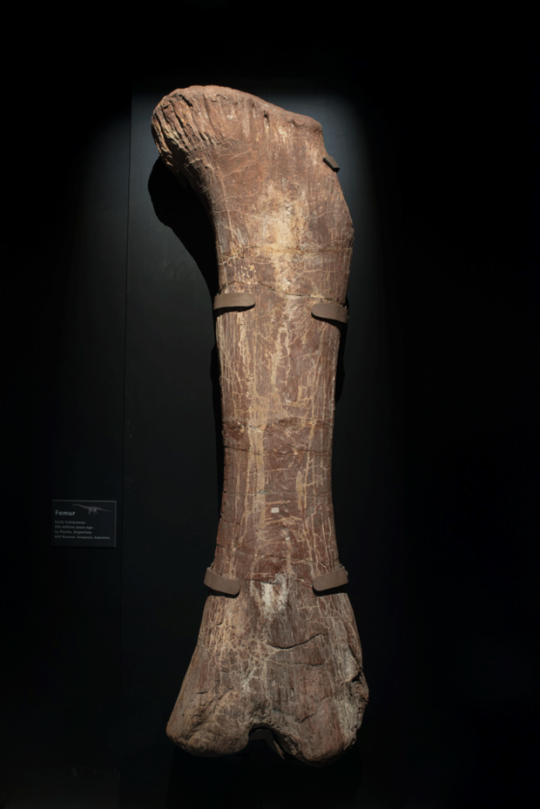
Back in 2014 we shared news of the awesome discovery of fossils belonging to one of the largest dinosaurs that ever walked the earth and its equally awesome name: the Titanosaur. Last week the American Museum of Natural History unveiled their model of this spectacular specimen, its largest by far measuring 122 feet long and approximately 17 feet tall.
The Titanosaur is so incredibly large that one room isn’t enough to contain it, so the dinosaur’s head stick out more than 10 feet outside the entrance to its home inside the Miriam and Ira D. Wallach Orientation Center on the museum’s 4th floor gallery. Were it alive today this dinosaur could lift its head, atop a 39-foot-long neck, to “peek into a five-story building.” It also would’ve weighed about 70 tons, which is about the equivalent of 10 African elephants. What’s even more mind-blowing still is that, based on cross-sections of the animal’s vertebrae, paleontologists think it was only an adolescent when it died, so not fully grown.
“To accompany this massive model, some of the creature’s real fossils, which were first excavated in Argentina in 2014, hang along the wall. While it is nearly impossible to recover all of the bones from any dinosaur, paleontologist Diego Pol and his team have recovered a remarkable 70% (over 200 bones!) of this one over the course of 7 different expeditions in 18 months. For the remaining 30% of the model, scientists have extrapolated from similar species and estimates based on the circumference of the dinosaur’s femur and humerus bones.”
Watch this video to see how the AMNH assembled their colossal new dino:
Whenever someone tries to claim that evolution is a lie, I send them a picture of platybelodon.
1. It’s an excellent example of transitional evolution.
2. It’s a mess who would intentionally do this and why
3. It makes them piss themselves a little.
“Evolution is just a theory-”
No intelligent people think “evolution” is a theory. But no intelligent people should think all life “evolved” from a single cell created by accident? I’m sorry, but really?
That would be abiogenesis! The source of life is a separate science from evolution itself, called abiogenesis, and refers to how life first occurred on earth. It’s still a source of a lot of theories because it’s so difficult to pinpoint the exact moment something becomes ‘alive’ and replicating the environment that existed billions of years ago to test hypotheses is near impossible.
Before I explain, I need to point out that the term ‘created’ doesn’t really apply, nor does ‘by accident’. An accident implies that there was another intended outcome, and ‘created’ implies it was intentional. It wouldn’t have been created or accidental any more than than trees growing mushrooms is an accidental creation. It’s just a thing that happened because the setup was right.
Chemicals have specific reactions and are predictable, so the forming of certain life sustaining elements wouldn’t be at all random. It may actually be the only likely outcome! Carbon and hydrogen are the most necessary chemicals we need for life, both of which were abundant in early earth’s atmosphere. Oxygen is actually much less necessary, and there wasn’t much oxygen in our atmosphere until after life had already begun. And it was only because of plants! Plants evolved first, and excreted oxygen, which resulted in the development of oxygen consuming life like us.
I’m not sure why you’ve put evolution in quotations, seeing as you say you believe in it, but I’m curious when you think it stops being applicable? Believing we all came from a single source is sort of a cornerstone of evolution. 99% of life that ever existed is now extinct, and all that life, past and present, traces back to a clade that lead us back to our common ancestors.
We can trace humans back through our primate ancestors all the way to our earliest, shared placental mammalian ancestor, which was shrew like and lived alongside dinosaurs (clade eutheria). This was the ancestor of all modern mammals that keep their fetuses alive with placentas, from humans and dogs to camels and whales. Monotremes like the platypus can be traced having branched off much earlier, and marsupials branched off near the same time we did.
But all these mammals can then be traced back to synapsids!
Which were mammal like reptiles, as strange as that sounds, with soft palates, differentiated teeth, and even hair.
The earliest synapsid can be traced back to over 300 million years ago! And we know through fossil evidence that synapsids branched off from basal amniotes. Basal amniotes include all egg laying creatures that laid their eggs outside of the water with a hard shell. (This included synapsids until mammals developed live birth.)
Diapsids branched off from those same amniotes, and diapsids are where we see the first reptiles, dinosaurs (this will include birds much later, as birds are still classified as avian dinosaurs), crocodilians, pterosaurs, ect.
Then we can trace those back to anamniotes, like the first cartilaginous fish! Anamniotes laid their eggs in water, due to not having a hard shell that kept the fetus from drying out. So now we have a single group we’ve traced all animal life back to, but we can still go further.
Along with those first fish, we saw the branching off of echinoderms like starfish. Those can be traced further back to have branched off of the same source as arthropods! Which include some of our most plentiful fossils like mollusks, segmented worms, sea scorpions, and especially the trilobite, which existed 521 million years ago.
Arthropods can then be traced back to much smaller life like roundworms, flatworms and rotifers. As we track back those tiny lifeforms, we find the first sea sponges, fungi, and the most exciting imo, the cnidarians. Cnidarians include jellyfish, anemones, and coral. These are so exciting because these are larger organisms that blur the lines between plant and animal, and they’re made up of lots of much smaller lifeforms. This is when we see animal life becoming what we know it as today.
Remember what I said earlier, about plants developing first? Well, that’s the final branch that we’re linked on the evolutionary tree before we reach eukaryotes.
A single celled organism that could produce both asexually and through meiosis, one of the earliest forms of sexual reproduction. Present in all modern day plants, fungi, insects and animals. Bacteria evolved long before that, but we’ve already gone back so far that we’ve found the single celled ancestor that connects all life on earth as we know it. We even have fossils of it!
(all other images are public domain but I legitimately can’t find an original source for this one, if any of my followers know where it came from please let me know)
So we know now that we all absolutely could and did evolve from a single celled organism, some 1.6 to 2 billion years ago! But this is all evolution, and evolution doesn’t explain where life originally came from.
And the truth is, we don’t know how life first started yet! It could’ve been a chemical reaction we haven’t yet reproduced, it could’ve been seeded here by an impacting asteroid, it could be some phenomenon we’ve never seen before. That’s what makes abiogenesis so exciting; There’s still so much left for us to discover. Scientists think we might even figure it out in our lifetime! Can you imagine?
(If anyone spots any inaccuracies or typos, please let me know. I’m typing this after pulling an all nighter so I’m not 100% haha. If you see something and don’t want to reblog the giant post, feel free to im me!)
In short – all life on earth can be traced back to a single cell via common ancestry, but exactly how this cell even showed up in the first place is currently anyone’s guess.






 Aw Yiss