Damn! Damn! Damn! Every year he forgot. Well, no. He never forgot. He just put the memories away, like old silverware that you didn’t want to tarnish. And every year they came back, sharp and sparkling, and stabbed him in the heart.
Every year May 25th comes around and every year I have the need to put into words just why this book stayed with me for so long. But mostly it comes down to this: despite Night Watch’s sudden shift to a darker, heavier dark tone, it avoids being unnecessarily cruel to its characters just for the sake of plot. And of course, this is true of all the Discworld books, people striving to be better, to do better, but I think it’s significant in context of how dark this book is – especially since going by chronological reading order, this is the bleakest book we encounter up until this point.
This Ankh-Morpork that we’re submerged in is so alien at that point in her timeline, it’s gruesome and cruel and oppressive because it’s under a gruesome, cruel and oppressive tyrant. Yet despite that, there is still kindness in the heart of the book – it values old Vimes’ mercy and young Sam’s innocence, it values the fact that Vimes wants to avoid undue violence, to save as many as he can,
and shield people from the tyranny for as long as he can.
It’s such an emotionally charged book and there is a lot of darkness in the story itself- a blood-thirsty serial killer, power-hungry men,
ruthless paranoia, and the awful, inhumane underbelly of a regime – but
where most other books would have so, it avoids traumatizing its characters just to establish that. Darker shifts in tone so often entails that the narrative doles out meaningless suffering and trauma just establish itself Night Watch ultimately avoids that, because it uses other means to make the text feel heavy and oppressive. Part of it is from the plot itself, in that Vimes knows what happens behind closed doors, he know what Swing is capable of and the knowledge of that threat is high-risk enough to let readers know of the stakes.
The main emotional conflict instead comes from Vimes battling with himself, reconciling with wanting to go home versus, well, Sam Vimes being Sam Vimes, which means doing his best at saving everyone, history, timeline and causality be damned. We know that young Sam will become cynical and bitter and drunk somewhere down the line, we know that half the Night Watchmen will die, we know that the city will remain cruel despite this Hail Mary attempt at revolution. Which is why the narrative is so intent on telling us that Vimes’ kindness matters – in mentoring young Sam, in getting the prisoners off the Hurry-Up Wagon, in preventing undue riots and undue brutality, in keeping the fighting away from Barricade as long as possible. The city’s going to hell in a hand basket, might as well make people’s lives easier.
Vimes can’t save Ankh-Morpork from history taking its due course, but the powerful emotional catharsis is seeing him coming to the decision to try and save everyone anyway – simply because he can’t envision himself not doing it. So he digs his heels in and makes whatever difference he can in the moment.
Because Night Watch in an inevitable tragedy – only one of the two stories can have a happy ending and in order for Sam Vimes to go back to the present, to his wife and his son and his Watch and his city, the revolution has to fail or else that timeline ceases to exist. There is no way for him to save both his men and his future but he’ll be damned if it doesn’t try – he wouldn’t be Sam Vimes otherwise. Every time it I re-read it still feels like he’s that close to succeeding.
It could have so easily been grimdark and ~gritty~ but ultimately it avoids because it centres on a few basic themes that forms the core in the story. The heart of it is about camaraderie of a handful of men too weird and incompetent and ugly, the tentative hope in the uprising, and the sheer bloody determination of Sam Vimes’ refusal to give up on the people around him.
I just also want to throw in – since there’s no better time to do it than the 25th of May – that one of my favorite thing about Night Watch is that it’s a book about consequences. The consequences of the past on the present, sure, but also the consequences of corruption, of revolution, of our behavior towards and about one another. And while that would be enough on its own, this beautiful brutal kindhearted story, my favorite thing about Night Watch is that the ENTIRE book is actually a consequence of the book before it – Thief of Time. If you haven’t ever done yourself the favor of reading these two books back to back, I HIGHLY recommend it; for one thing, Lu-Tze and Susan and Lobsang are three of my favorite characters ever, and for another, Thief of Time’s conceptualization of time itself is really beautiful and fascinating and, in its way, haunting. Like Night Watch, it’s a beautiful book on its own, but like Night Watch, it is best read with its partner.
The point being, this is a great post and it should feel great BUT ALSO pls read Thief of Time, because all the good things about Night Watch are only amplified when you’ve read them both. (I mean, for one thing, it will leave you with the happy knowledge that history shattered, and despite having no part in causing that or even knowing it had happened, Sam Vimes still ended up cleaning up a big chunk of the mess, because OF COURSE HE DID. Ugh, Sir Terry, you beautiful genius, I hope you are resting in peace. Thank you for helping ensure I live in interesting times.)
so. they made a new german discowrld essentials edition, with a new covers (which is good because the old ones are real bad)
and they are these manga-like ‘build a picture’ style, which i like
but. oh my god. look at that vimes
this isn’t samuel ‘worked the night-shift for 30 years, runs on coffee and spit, has probably not slept more than 3hours any given day’ vimes
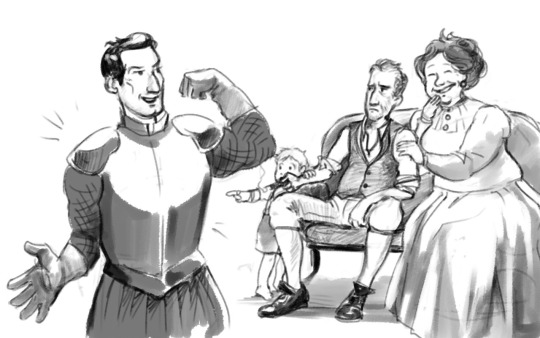
this is the guy who played vimes in murder-mystery play, ‘inspired by real events’. hammy acting, horrible script, ‘Clues’ everywhere, heroic fightscenes, big speaches. Vimes threadened to shut the whole thing down for slander. Sybil probably got an autograph
I’ve been staring at this post for 15 minutes and I can’t stop laughing omg omg I’m seeing stars oh no.
Sybil invited the damn company to the house for their afterparty and you know it.
the actor earnestly explains at one point the fitness routine he undertook to ‘get in character’ for the part of the ‘heroic commander’ while pointing at various melon-sized muscle groups. vimes himself is sitting there shoveling something that’s 98% grease by volume into his face and also staring balefully. he’s never done a pushup in his life. he wouldn’t know a fucking pushup if it spat on him in the street. sybil is doing her absolute best not to laugh and her best is nowhere good enough. the actor, encouraged by the (presumably) admiring male stares and flirtatious female giggles, goes on to describe his hair-care regimen.
Nooooooo oooooonnnnne stops coups like Sam Vimes
Distrusts clues like Sam Vimes
No one lives off of Klatchian brews like Sam Vimes
He’s especially good at in-VEST-igating
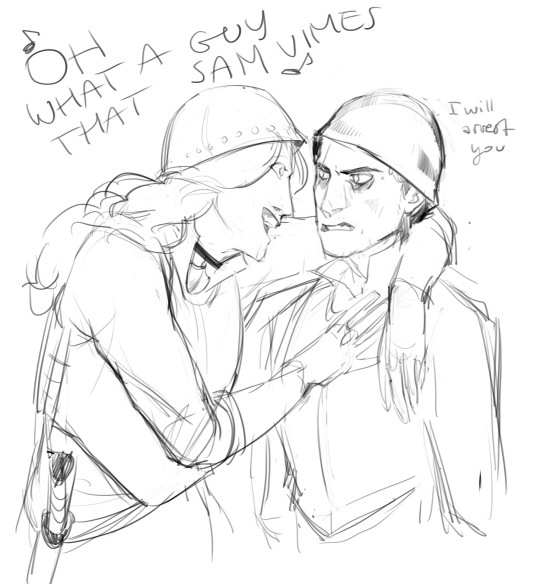
My what a guy, that Sam Vimes
This post got better since I saw it last night oh my gods.
Thank you @roachpatrol I don’t think I’ll ever stop laughing now.
Sorry @roachpatrol for hijacking your post but that was just hilarious and i had to draw it….
(It’s hard to draw Vimes out of uniform! But I guess even he doesn’t wear armour 24/7…)
(Young Sam is like ‘daddy, I want an armour like that!’)
I’m sure Angua loved it too
And then she run
OH WOW I love your Vimes! And Angua messin’ with him is beautiful. 😀
why didn’t i see any of these illustrations earlier THEY’RE GREAT
“No one is finally dead until the ripples they cause in the world die away—until
the clock wound up winds down, until the wine she made has finished
its ferment, until the crop they planted is harvested. The span of
someone’s life is only the core of their actual existence.”
Terry
Pratchett – Reaper Man
Its been a year already, but the ripples have yet to fade.
Y’know an awful lot of Terry Pratchett’s books are concerned with how powerful women are when they get angry and how important anger is as a driving force to defend what is right and to tackle injustice.
A lot of his most interesting and most deeply moral characters are angry ones. Granny Weatherwax, Sam Vimes, Tiffany Aching. All are to a large extent driven to do good by anger.
And that honestly means a lot to me.
Terry was an angry man. This is not the same as saying he was a bad man. He held a righteous fury, the kind that comes from looking at the world, and knowing just how much better it could be if only we stopped being bastards. He held a genuine belief that people can and do change the world for the better, not by big things, but by the little. He believed in the kindness of others, and that kindness means more than wishing well and prayers. He knew the difference between being good and doing good, and that you technically couldn’t be the first without the latter.
He was angry at the world because he loved it, and he wanted us to feel the same, to not feel helpless, to know that something can be done, to know that anger is not just the tool of abusers and tyrants but the chisel by which The People might chip away at oppression and fear and bring it crumbling down. He gave us the drive needed to believe in hope. because he wanted to make the world better with words and not violence.
I hope he knows that he did.
Pratchett went back to older throwaway jokes (like dwarves being apparently unisex) and used them as metaphors to discuss social change, racial assimilation, and other complex issues, while reexamining the species he’d thrown in at the margins of his world simply because they existed at the margins of every other fantasy universe. If goblins and orcs and trolls could think, then why were they always just there to be slaughtered by the heroes? And if the heroes slaughtered sentient beings en masse, how heroic exactly were they? It was a long overdue start on redressing issues long swept under the rug by a parade of Tolkien successors who never thought of anyone green and slimy as anything but a notch on the protagonist’s sword, and much of the urgency in Pratchett’s last few books seemed to be related to them. “There’s only one true evil in the world,” he said through his characters. “And that’s treating people like they were things.”
And in the last of his “grown-up” Discworld books, that idea is shouted with the ferocity of those who have only a few words left and want to make them count. Goblins are people. Golems are people. Dwarves are people, and they do not become any less people because they decide to go by the gender they know themselves to be instead of the one society forces on them. Even trains might be people, and you’ll never know one way or the other unless you ask them, because treating someone like they’re a person and not a thing should be your default. And the only people who cling to tradition at the expense of real people are sad, angry dwellers in the darkness who don’t even understand how pathetic they are, clutching and grasping at the things they remember without ever understanding that the world was never that simple to begin with. The future is bright, it is shining, and it belongs to everyone.



 Aw Yiss