me, beating the goblin with a stick: no!!! its nice having my positive traits acknowledged!! responding to affirmation by denying it doesn’t make anybody feel good! the goodness in me isn’t always visible to myself, and i won’t put myself down when people see it! i deserve compliments!
hideous brain goblin, spitting blood: they’re lying to you to make you feel bet–
me, loading my shotgun: I’ll Feel Better And That’s What Matters, Shitlord. Making Those Assumptions And Festering On Them Will Only Hurt Me And The People Who Genuinely Do Mean Their Compliments. If I Assume The Worst In Praise, I Won’t See The Best In Myself.
1. Don’t waste time being fearful: go for that job that you’re certain you’re not gonna get. What’s the worse that can happen? You are rejected, but you gain interview experience. Self-doubt is really a waste of time.
2. Live in the present. Yes, it is important to plan for the future, but it is easy to put off living until it is too late. Make sure that you have no regrets about what you should have done. Do one exciting thing per year.
3. Know your worth. This applies to both work and relationships; never sell yourself short. No job or romance is more important than your self respect. Also, charge for any unique skills/services that you can offer.
4. Don’t be afraid to leave bad situations. I left a stable but draining teaching job in order to protect my mental health. Even though this was a big risk, it was the best decision I ever made. NOTHING is more important than your mental health.
5. Most 20 somethings feel that they are underachieving. This is normal – especially in today’s financial climate. Don’t feel bad if you are still living at home and cannot afford to rent/buy. I’m 30 and still living at home, saving to buy.
6. People will disappoint you, but most of the time, it’s not about you. Everybody has their own demons and traumas that make them behave in certain ways. If somebody disrespects you, assert your boundaries and keep it moving. Also, examine if there was anything you could have done to avoid the situation. But DO NOT let it eat away at you.
7. In love, nobody owes you anything. Even if they made a promise, they are their own person…Everybody has the right to change their mind and to leave a situation which is not beneficial for them. This is hurtful and hard to accept, but it is the truth.
8. Learn to enjoy your own company. Your 20s can be a lonely time as your social sphere narrows, due to employment, finances and exhaustion. Use this time to find out more about yourself and do the things that you enjoy. There is something liberating about eating at a restaurant alone.
9. Be kind, don’t gossip or overshare. I am still working on this one. It is really difficult to be kind and positive in a world full of annoying people. However, your attitude will influence how you are being perceived. If you are unkind, people will laugh at your jokes but they will never trust you. They will never trust you not to treat them as you treat other people. Remove yourself from toxic people, and only share negativity (sadness/anger/depression) with a therapist and one other person that you trust. If you overshare negative feelings, you may be stereotyped as being full of drama. Furthermore, people will want you to stay in a negative place because it’s entertaining and makes them feel better about their own lives. Just don’t do it.
10. You cannot win every battle. Within conflict, it is tempting to try to force others to agree with your perspective. However, most people are set in their ways, and find it difficult to change their views and behaviours. This is especially important when dealing with toxic family members. You may never get the apology and empathy that you seek, so it is important to accept that every battle cannot be won, and gain validation internally, rather than externally.
The Guardian, Tumblr and Univision are working together on a 24-hour digital event on climate change – and we want you to get involved. Submit your posts here.
When a toxic person can no longer control you, they will try to control how others see you. This misinformation will feel unfair, but stay above it, trusting that other people will eventually see the truth just like you did.
So, you’ve read something that has resonated with you. It’s everything you’ve wanted in terms of characters, prose, plot and pace. It’s the best you’ve read in years. You reread your favourite lines. You have to take a break just to absorb every meticulously crafted line. You are in awe of how something so small can seem to take up so much space.
And in a perfect world, it would inspire you to go out and create. To work on that story that is languishing in your save files, to pick up that WIP you abandoned, to make you want to write something different and new and better.
Instead, it makes you feel inferior. The words are too good. You could never write like that. The characters are too perfect. You don’t have that insight. The story is too captivating. Your ideas are boring, cliche, plain. The insight is remarkable. You can barely string a thought together coherently.
Why even bother, you think.
Don’t fall into that trap. I have been there so many times. I have abandoned writing for years because of “why even bother”. I have let it destroy my confidence, only to patch it back up in a cheap imitation of what it once was, just to let it invade my thoughts again. I have questioned every thing I’ve written, every choice, every line, because why even bother if someone is so much better.
YOUR WRITING HAS MERIT. What you don’t realize is that it’s not in terms of better, but different. Different style, different story, different interpretation, different mind.
Someone out there will love the way you describe the night sky in poetry. Someone out there will love the way you describe the look on someone’s face when their heart breaks. Someone out there will love your idea, that strange one that seems impossible or already done, because it’s new and exciting or they love endless amounts of that same story. Someone out there will love your interpretation of that character, whether more gentle or bitter or broken or healed. Someone out there will love the words you write, the grandiose use of adverbs (my guilt) or the minimal scattering of dialogue. Someone out there will love your abundance or lack of something you saw in that story you so loved, the one that rendered you speechless and snuffed out your fire.
Someone out there will love your words. And you need to share them.
Speaking as a writer, no one sets out to create something to discourage others. No one wants to dominate their corner and be the only one there. No one wants to be alone in their craft. If they do, they are doing it for the wrong reasons. Speaking as a writer, I would never want you to read my writing and think, why bother.
I want you to think, why bother waiting?
Your story matters. Your writing matters. It’s beautiful and defined and gorgeous and a work in progress and growing and already there and insightful and mysterious: it all has merit.
Never stop. Never stop writing and practicing and doing and creating and learning and loving the words you weave.
You may think someone has done it more beautifully or better or too many times or never because who wants to read it?
They maybe have done all those things, but they lack one thing: they haven’t done it like you have.
Thank you, I needed this.
One thing that helps me get over this is to go back and re-read my own fics. Usually not the newer ones, but the older ones, where I’ve forgotten the exact gist of the story and no longer have a really strong impression of what I wanted that story to be (and thus a strong impression of how short it fell once it actually existed) to get in my way. Nothing makes me want to write more than going “wow, I wrote this, and it’s pretty decent!” about fics I wrote a year or more ago.
Comparing myself to other writers is a very, very bad idea. Enjoying my own past fics, while at the same time thinking about the ways I would improve on them if I were to write them now, is typically pretty inspiring.
In my treks over the internet, I have seen various people (mostly social justice people) worrying that they are somehow harming Real disabled people if they use a wheelchair if they can still walk a little or use stim toys or these nifty color communication badges if they aren’t autistic. Similarly, I have seen various people (mostly anti-social-justice people) who believe that Fake Disabled People are running around pretending to be disabled and using color communication badges and wheelchairs and so on, and this hurts disabled people somehow (they have never quite specified how).
This is completely fucking wrong.
In universal design, there’s something called the curb cut effect. Basically, things intended to benefit people with disabilities wind up benefiting everyone. Curb cuts, which are intended for wheelchair users to be able to get on sidewalks, help bicyclists, parents with strollers, delivery people, and a dozen other nondisabled groups. Similarly, closed captioning, which was originally meant to benefit Deaf people, helps people who have trouble with auditory information processing (hi!), people who like talking during films, and people trying to watch TV in noisy bars.
The curb cut effect is accessibility activists’ secret weapon. You see, people don’t generally want to accommodate disabled people any more than they have to. Accommodating disabled people is a pain in the neck, and disabled people are generally a small and relatively powerless group with limited ability to complain. However, if any TV network tries to remove closed captioning, they won’t just have to put up with complaints from Deaf people. They will have to put up with complaints from everyone who has ever tried to watch TV in a noisy bar. The latter is far more likely to strike fear in the TV executive’s heart.
Furthermore, pretty much anything that’s limited to disabled people only has to have some sort of process for figuring out who’s disabled. This presents numerous issues. Many disabled people don’t know they’re disabled. (Raise your hand if you’ve had a conversation with someone who thinks that ADD or depression isn’t real because everyone acts like that, right?) Many disabled people struggle with feeling like “fakers” and won’t ask for accommodations that they need. Many disabled people who do know they’re disabled can’t prove it: healthcare access is often limited for poor people, people of color, trans people, and so on; navigating bureaucracy requires skills like being able to talk to people, show up places at a scheduled time, and do things that you intended to do, that many mental illnesses and developmental disabilities make difficult. Every time you say “this is for disabled people only”– whether by limiting it to disabled people institutionally or by criticizing people who do it and whom you don’t think are disabled enough– a lot of disabled people don’t get access to it.
Sometimes this is a cost worth paying. For instance, we can’t let everyone bring their dogs into every public space, because service dogs have to be specially trained to not be disruptive in stressful situations. This training is expensive but service dogs are usually free, meaning that the number of service dogs available is limited, so we can’t have service dogs available to everyone who wants one. In this case, the alternatives are much worse and the cost is worth paying. But the cost is still a cost.
And notice that the people who decide who gets service dogs are the client’s medical professionals, not random strangers. It is never okay for random strangers to decide if someone is disabled enough for an accommodation. For instance, some store owners will only let service dogs in if they think the person is “really” disabled. This is wrong (and also illegal by the Americans with Disabilities Act). Other people will make fun of wheelchair users who can stand up. It is a major violation of privacy to expect random strangers to disclose their private medical history to you. You are far more likely to be harassing an actually disabled person to be criticizing a nondisabled person. And even if the person is nondisabled… who cares? Nondisabled people using wheelchairs does nothing but create a larger pro-wheelchair demographic, which benefits disabled wheelchair users. There is no call to be the Disability Police.
For a specific example, consider one of my friends, who started flapping his hands when he was happy because he thought it was adorable and later found out that flapping your hands when happy is a common symptom of autism. He freaked out, worrying that he was appropriating autism somehow. However (as I told him at the time) actually nonautistics flapping their hands works out great for autistic people. A culture in which the default reaction to happy hand-flapping is “ohmigod, adorable” rather than “you freak” is a culture in which autistic people do not have to waste energy suppressing their natural ways of moving. And because he’s nonautistic, it’s much easier for him to explain to people who dislike hand-flapping why it is wrong to do so, which helps to create a more welcoming environment for autistic people.
Similarly, I’m nonautistic, but I do flap my hands when I’m experiencing intense emotion. Unlike many autistic people, it is possible for me to stop. Think about it like not smiling when you’re happy: it’s possible for most people to do so (especially if they get mocked for being weird every time they smile) but instead of being fully present in the moment you’d have to be continually conscious of your facial expression lest your lip twitch when you’re not thinking about it. If we say “you must be This Autistic to flap”, then I still have to police what my hands are doing, which goes against the whole point. But if we say “everyone gets to express happiness in the way most natural to them, unless you express happiness by punching people in the face or something”, then everyone gets to express happiness in the way most natural to them (yay!) and we have lots of people invested in creating a culture where that stays true (yay!).
In conclusion: if an accommodation helps you and you can get it without proving you’re disabled (i.e. as you must to get a service dog), you should use it. If using a wheelchair helps you move faster and farther than you would otherwise, use a wheelchair. If stimming makes you happy, stim. If those nifty communication cards help you express your communication preferences (and they are available at whatever event you’re at, which seriously why is that not every event, they are so cool), use them. And it is wrong to disability police people. If someone does not seem disabled enough to use an accommodation to you, then you should be quiet and mind your own business instead of harassing them about it. In the vast majority of cases, nondisabled and less disabled people using something is helpful to more severely disabled people, and when it is not, it is the job of medical professionals to decide, not you.
Every time you say “this is for disabled people only”– whether by limiting it to disabled people institutionally or by criticizing people who do it and whom you don’t think are disabled enough– a lot of disabled people don’t get access to it.
this is such a good post.
When a toxic person can no longer control you, they will try to control how others see you. This misinformation will feel unfair, but stay above it, trusting that other people will eventually see the truth just like you did.
Wall sticker in Marlborough lesbian pub, Brighton.
i’m actually realizing this now
but the original poster said “queer power” and someone erased that and replaced it with “gay power”
real classy
#is this real
Well. I’m not exactly an expert at image analysis, but the bottom text in the first one looks much cleaner than the top text while the second one matches better. Also, the creases in the second one on the Q and U seem like the sort of detail that wouldn’t be faked. Finally, this actually matches up significantly better to “queer” politics than “gay” politics; it was always queers who advocated and took the front lines in direct action.
If you put the image in an editor or just view the full size of the first image, it becomes very obvious that the text on the bottom was added later: all of the vertical lines in every letter are pixel perfect straight lines. That is basically impossible with a photo of a poster that is both visibly at an angle, and has paper weathering and other distortion. Look at the verticals of the white text to compare. The only distortion of the text is the jpg artifacts we would expect in that level of contrast. There is no lighting on the pink text either, another highly suspicious trait.
Additionally, if you crop out the pink text in op and run an image search you get the second photo, as well as four or five other photos of the poster, all reading “queer power.”
With the pink text left in, however, the only version of the poster is this exact image, sourcing to op.
I want every single person who ever argued with me on That Queer Post to take a long, hard look at this. I have been told at least dozens of times that “nobody is saying you can’t identify as queer,” that I’m “ignoring history,” that they’re not trying to shift back to gay, etc.
Now, here’s this post, in which queer people are having their art defaced in order to rewrite their identity. Where they’re being forcibly rewritten as gay. Where history is being literally goddamn erased. It’s got three times the notes of That Queer Post, and as far as I can tell, @bifoxstiles is the first one to challenge this narrative. And I’m not gonna hold my breath on y’all to call out OP.
They’re literally stealing our history, rewriting it into a new version that excludes more than half of the community. And nobody’s challenging this. You’re too busy trying to shut down inclusive, egalitarian language.
Shame on every last one of you.
Uhhhh. That’s like a really famous poster, at least if you are over a certain age. I recognized it immediately.
Yeah. It… it never said ‘Gay Power’ originally. It said ‘Queer Power.’
What the actual fuck.
OKAY KIDS. HISTORY LESSON TIME.
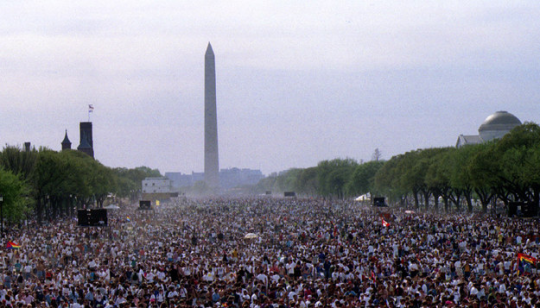
Ironically, just before this crossed my dash, Oxford University Press shared a link to a new archive of queer oral history. If not for Tumblr’s recent push to wipe “queer” from our collective memory, I wouldn’t have thought twice about OUP using the term. After all, it was chanted in pride and defiance when over a million of us participated in the 1993 March on Washington to demand an end to discrimination…
Video clip from that day: “We’ve come to Washington to show everyone that we’re here, we’re queer, and we’re not going anywhere!”
In the past year, I’ve seen some Tumblr members trying to suppress the word “queer,” just as people back then tried to suppress us. The excuse is that it’s sometimes used as a slur. But so is “gay.” In my 45 years, I have heard/seen “gay” used as an slur far more often.
At first, I tried to respect the fact that “queer” bothered some Tumblr users, even though it was painful for me to see queer-positive posts tagged “q slur.” But the more I thought about it, the more I realized that caving in to those asking us to drop the term “queer” would permit homophobic and/or transphobic sensibilities to define our identities.Do we have to drop “gay” now as well, or tag it “g slur”? Since when did we stop reclaiming these words as a matter of pride?
Isn’t this just the latest ploy of internalized homophobia/transphobia sneaking up on us?
Unfortunately, erasing “queer” from our vocabulary has hurtful real-world consequences.
Silencing “queer” silences many of those who fought, marched, rioted and died for your rights. It erases those of us who are queer but not gay: trans, intersex, nonbinary, lesbian, bisexual, aromantic, asexual people, and more (see why the term is so necessary?) Erasure/minimization of queer people is how we end up with disrespectful historical revisionism like that Stonewall movie. Or the Photoshopped poster above, rewriting our history with a lie.
And that’s the real kicker.
Erase “queer” from our vocabulary, and we erase future generations’ ability to learn about their past. How will they be able to find LBGTA+ history, if you teach them not to use one of the main keywords they need to search for to find it?
How much of our past and present community will be rendered invisible and their needs ignored (this article is really, REALLY worth a read), if those now lobbying against the term “queer” are successful?
Decades ago, when being out was taking a huge risk, we chanted, “We’re here, we’re queer, get used to it!” It would be a bitter irony if, even as mainstream society becomes “used to it,” as demonstrated from the Supreme Court to the bridge of the U.S.S.Enterprise, our own community becomes less “used to it.”
Think about the forces of prejudice who were trying to silence us when that “queer power” sign was made. Please don’t let them win.



 Aw Yiss