i just found out merriam webster has a time traveler feature that tells you some of the words that were “born” the same year as you. it’s pretty neat yall should do this
Throwback to the time my poor German teacher had to explain the concept of formal and informal pronouns to a class full of Australians and everyone was scandalised and loudly complained “why can’t I treat everyone the same?” “I don’t want to be a Sie!” “but being friendly is respectful!” “wouldn’t using ‘du’ just show I like them?” until one guy conceded “I suppose maybe I’d use Sie with someone like the prime minister, if he weren’t such a cunt” and my teacher ended up with her head in her hands saying “you are all banned from using du until I can trust you”
God help Japanese teachers in Australia.
if this isnt an accurate representation of australia idk what is
Australia’s reverse-formality respect culture is fascinating. We don’t even really think about it until we try to communicate or learn about another culture and the rules that are pretty standard for most of the world just feel so wrong. I went to America this one time and I kept automatically thinking that strangers using ‘sir’ and ‘ma’am’ were sassing me.
Australians could not be trusted with a language with ingrained tiers of formal address. The most formal forms would immediately become synonyms for ‘go fuck yourself’ and if you weren’t using the most informal version possible within three sentences of meeting someone they’d take it to mean you hated them.
100% true.
the difference between “‘scuse me” and “excuse me” is a fistfight
See also: the Australian habit of insulting people by way of showing affection, which other English-speakers also do, but not in a context where deescalating the spoken invective actively increases the degree of offence intended, particularly if you’ve just been affectionately-insulting with someone else.
By which I mean: if you’ve just called your best mate an absolute dickhead, you can’t then call a hated politician something that’s (technically) worse, like a total fuckwit, because that would imply either that you were really insulting your mate or that you like the politician. Instead, you have to use a milder epithet, like bastard, to convey your seething hatred for the second person. But if your opening conversational gambit is slagging someone off, then it’s acceptable to go big (”The PM’s a total cockstain!”) at the outset.
Also note that different modifiers radically change the meaning of particular insults. Case in point: calling someone a fuckin’ cunt is a deadly insult, calling someone a mad cunt is a compliment, and calling someone a fuckin’ mad cunt means you’re literally in awe of them. Because STRAYA.
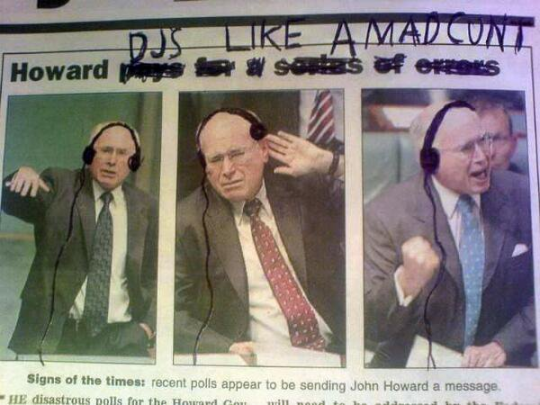
case in point: the ‘Howard DJs like a mad cunt’ meme.
extra pro level aussie: calling a stranger mate. depending on context, they’re either about to become your new best friend, or someone’s about to get king hit.
@determamfidd your country fascinates, confuses and frightens me in equal measure
seriously my darlingest @culturalrebel, if Strayans had informal and informal pronouns, we would only use the formal ones to indicate how much we HATED the person we were addressing. We’d manipulate it to say ‘THIS PERSON IS SO FAR UP THEMSELVES THEY NEED A HARD HAT AND A TORCH.’
THE cardinal Australian sin is to be ‘up yourself’. To be ‘up yourself’ is to be an arrogant person who thinks and acts as though they are better than others.
‘Bitch’ is either a killing insult or a term of affection. Same with ‘bastard’ and ‘dickhead’. ‘Wanker, however,’ is ALWAYS an insult. We use ‘wanker’ for the same sort of thing as ‘up themselves’ – a wanker here doesn’t just mean an annoying person, it also means someone who elevates themselves above others, insists on preferential treatment, etc.
And yeah, if someone you’ve just met calls you ‘mate’ in a particular tone of voice, you’re about to get punched.
is “chai” a TYPE of tea??! bc in Hindi/Urdu, the word chai just means tea
its like spicy cinnamon tea instead of bland gross black tea
I think the chai that me and all other Muslims that I know drink is just black tea
i mean i always thought chai was just another word for tea?? in russian chai is tea
why don’t white people just say tea
do they mean it’s that spicy cinnamon tea
why don’t they just call it “spicy cinnamon tea”
the spicy cinnamon one is actually masala chai specifically so like
there’s literally no reason to just say chai or chai
They don’t know better. To them “chai tea” IS that specific kind of like, creamy cinnamony tea. They think “chai” is an adjective describing “tea”.
What English sometimes does when it encounters words in other languages that it already has a word for is to use that word to refer to a specific type of that thing. It’s like distinguishing between what English speakers consider the prototype of the word in English from what we consider non-prototypical.
(Sidenote: prototype theory means that people think of the most prototypical instances of a thing before they think of weirder types. For example: list four kinds of birds to yourself right now. You probably started with local songbirds, which for me is robins, blue birds, cardinals, starlings. If I had you list three more, you might say pigeons or eagles or falcons. It would probably take you a while to get to penguins and emus and ducks, even though those are all birds too. A duck or a penguin, however, is not a prototypical bird.)
“Chai” means tea in Hindi-Urdu, but “chai tea” in English means “tea prepared like masala chai” because it’s useful to have a word to distinguish “the kind of tea we make here” from “the kind of tea they make somewhere else”.
“Naan” may mean bread, but “naan bread” means specifically “bread prepared like this” because it’s useful to have a word to distinguish between “bread made how we make it” and “bread how other people make it”.
We also sometimes say “liege lord” when talking about feudal homage, even though “liege” is just “lord” in French, or “flower blossom” to describe the part of the flower that opens, even though when “flower” was borrowed from French it meant the same thing as blossom.
We also do this with place names: “brea” means tar in Spanish, but when we came across a place where Spanish-speakers were like “there’s tar here”, we took that and said “Okay, here’s the La Brea tar pits”.
Or “Sahara”. Sahara already meant “giant desert,” but we call it the Sahara desert to distinguish it from other giant deserts, like the Gobi desert (Gobi also means desert btw).
Languages tend to use a lot of repetition to make sure that things are clear. English says “John walks”, and the -s on walks means “one person is doing this” even though we know “John” is one person. Spanish puts tense markers on every instance of a verb in a sentence, even when it’s abundantly clear that they all have the same tense (”ayer [yo] caminé por el parque y jugué tenis” even though “ayer” means yesterday and “yo” means I and the -é means “I in the past”). English apparently also likes to use semantic repetition, so that people know that “chai” is a type of tea and “naan” is a type of bread and “Sahara” is a desert. (I could also totally see someone labeling something, for instance, pan dulce sweetbread, even though “pan dulce” means “sweet bread”.)
Also, specifically with the chai/tea thing, many languages either use the Malay root and end up with a word that sounds like “tea” (like té in Spanish), or they use the Mandarin root and end up with a word that sounds like “chai” (like cha in Portuguese).
So, can we all stop making fun of this now?
Okay and I’m totally going to jump in here about tea because it’s cool. Ever wonder why some languages call tea “chai” or “cha” and others call it “tea” or “the”?
It literally all depends on which parts of China (or, more specifically, what Chinese) those cultures got their tea from, and who in turn they sold their tea to.
The Portuguese imported tea from the Southern provinces through Macau, so they called tea “cha” because in Cantonese it’s “cha”. The Dutch got tea from Fujian, where Min Chinese was more heavily spoken so it’s “thee” coming from “te”. And because the Dutch sold tea to so much of Europe, that proliferated the “te” pronunciation to France (”the”), English (”tea”) etc, even though the vast majority of Chinese people speak dialects that pronounce it “cha” (by which I mean Mandarin and Cantonese which accounts for a lot of the people who speak Chinese even though they aren’t the only dialects).
And “chai”/”chay” comes from the Persian pronunciation who got it from the Northern Chinese who then brought it all over Central Asia and became chai.
Saving the thorn from obscurity Is surely a laudable aim But if this letter deserves our praise The eth should receive the same.
The scribes of the Anglo-Saxons interchanged the eth and thorn until the first one fell from use and the second was left forlorn,
But for the modern Icelander their roles are more defined and could improve our English texts if we were so inclined.
The thorn (Þ, þ) denotes a voiceless dental fricative as in the English ‘think’ or ‘thresh’ but not the ‘th’ in ‘hither,’ whereas the eth (Ð, ð) is a voiced dental fricative perfect for ‘this’ and ‘that’ and most especially for ‘thither.’
So I propose ðey boþ be used in the Icelandic manner; ðen students won’t be loaþ to learn our spelling and our grammar.
To þink we’ve never fixed ðis mess is really quite astounding. One letter cluster for two sounds? Ðat’s damnably confounding!
A (short) pronounced like the spanish “padre”. Á (long) pronounced like the english “father”.
Found in axa (cleft/ravine), Alataire (the great sea), alda (tree), anar (sun), andúne (sunset) and arda (the World/realm).
Inspired by a conversation with @determamfidd and will be continued with every letter.
Somewhere in Australia, in a nice house, with an ordinary family (child, mom, dad) there lived a Dets.
Dets often sat behind her laptop. Tippy-tapping the keys and putting words on the screen. Amazing words, that weave a story, that many people love.
But we’re getting sidetracked, in between these writing (and blog) sessions, Dets juggles a Dwarfling, husband, job and of course real life!
And upon realising this, respect for Dets often raises. She’s nice and helps people who need it. She is humble and admits when she is wrong! Which even makes her a more amazing human being!
But the most important thing is, it’s Dets her birthday today. And thus, like 12 hours away from where I live, is an amazing person celebrating this happy day with her family!
Happy birthday Determamfidd!
Fijne verjaardag, lieve Dets! Maak er een leuke dag van en geniet zo veel mogelijk!
(Happy birthday, dear Dets! Have a nice day and enjoy it to the fullest!)
((((Unlike 18th century writing, commas in Dutch aRENT implying a different meaning, not did I intend that))))
Oh my god Nina. Nina. I have been making Captain Flappy hands at the screen for the last five minutes, trying to put into words how grateful and speechless and touched I am. By this. This is just so kind and sweet and nnngh I can’t, it’s like a ball of huge formless happy sitting just in my chest, and it’s crowding out every word I’ve ever known or read, it’s just NNNNGH
I realize most people on here are too young to remember the Bush years but when you guys frame your SJ posts as “you hate[x]!!! why do you hate [x]???” it sounds an awful lot like how Bush supporters would scream WHY DO YOU HATE AMERICA???? whenever anybody would criticize the president.
So that’s something to consider if you want to reach people over 25. Because most of us have an extremely negative conditioned response to that type of rhetoric.
Yeah.
There’s a surprisingly sharp generation gap on Tumblr–when I first got on the site in 2011 it was between high-school age and college age, but I don’t think it’s defined primarily by life stage or maturity level, because it’s tracked steadily upward ever since. Anecdotally, right now the split seems to be centered around age 23, plus or minus a couple of years on either side, which corresponds roughly to the birth years 1990-1994. My hypothesis for the generation gap boils down to “how old were you on September 11, 2001?” Those solidly on the older side of the gap were at least vaguely aware of a pre-9/11 political landscape, witnessed how disruptive the first term of the Bush administration was, and have a visceral reaction anything that smacks of neoconservatism or Religious Right propaganda. Those on the younger side attained political awareness in a world where the changes wrought by the Bush administration were the new normal, and their right-wing bogeyman uses Tea Party and GamerGate rhetoric.
So for the record, Bush-era “innovations” that unnerve the FUCK out of people on the older side of the generation gap:
– Casual acceptance of fear as an excuse for hatred and pre-emptive retaliation
– An “ends justify the means” approach to stamping out the slightest trace of vulnerability, no matter how repressive the means, or how slight or unlikely the potential harm
– “If you’re not marching in lockstep with us, you’re one of THEM, why do you hate all that’s good and noble?” / “Dissent and safeguards against the abuse of power just give aid and comfort to the enemy” / “Don’t you SEE that insisting that the protections of civil society apply to THOSE PEOPLE is just going to GET OUR PEOPLE HURT, YOU’RE HURTING PEOPLE YOU MONSTER”
– Anything that smacks of religious-fundamentalist logic or rhetoric
These things are not normal. These things are not how just societies are built. They are the hot water that an entire generation of lobsters has been raised to swim in without noticing. The undercurrents in the internet movement calling itself Social Justice that disturb the older generation are, essentially, the dirty tactics of the Bush administration and its unholy marriage of neocons and fundies–rebranded with a new set of acceptable targets, but with the tactics themselves unquestioned. Are they the younger generation’s fault? Fuck no. They’re what happens when the most culturally and politically powerful nation on Earth tries to pretend it’s moved on from the Bush years, but without ever having confronted the devastation those tactics left in their wake, dismantled the self-sustaining fear-and-repression machine, or held the perpetrators accountable for their officially-sanctioned torture, shredding of civil liberties, and thinly-justified wars of aggression.
So if I were to do the annoying geezer thing (at the ripe old age of 27) and Address The Youth, I guess what I’d say isn’t just that most people over 25 get an overwhelming urge to throw up in their mouths at the slightest sign you’re playing “but why do you hate freedom” Mad Libs. (Although that’s true.) It’s more than that. It’s that “why do you hate [x]???” belongs to an entire toolbox of fear/attack, ingroup/outgroup, and absolutist tactics that we’ve left lying out without bothering to re-affix the giant warning labels that they aren’t normal, or necessary, or even effective over the long term, however tempting they may be for a quick fix. And that it’s okay to refrain from using them.
The bad guys will not win if you ease off the attack a little and give your opponents room to tell you where they’re coming from. Opening yourself up to argument-counterargument with Bad, Unacceptable, Forbidden ideas is a form of vulnerability, but finding and evaluating the weak spots in your beliefs ultimately strengthens them and strengthens your ability to win people over to your side. Doubling down on the repeated assertions that you shouldn’t even have to argue and that disagreement is harmful or immoral is an alluring way to get what you want in the short term, but it produces superficial compliance out of fear rather than genuine agreement, and the backlash it causes is ultimately more dangerous than the vulnerability of opening yourself to disagreement. And it blinds you to the possibility that you may not be entirely in the right. This isn’t some MRA sneak attack to manipulate you into ceding ground. This is how discussion normally works in a functional society. You have been handed a dysfunctional, toxic system for exchanging ideas, in online SJ as well as in wider politics–and no, it’s not normal or effective, and no, you do not have to buy into that system’s claims that it’s the only thing standing between the innocent and an orgy of destruction and victimization.
The strangest thing about this is that I would not consider myself particularly old (does anyone?) but I was in my late teens on 9/11, and yeah. This is exactly what I find unnerving about the approach of some younger people to SJ issues. For a long time I just put it down to (im)maturity, but I’m really starting to think that there’s something fundamentally toxic and broken about the way our country has been approaching these things for the last 15 years or so. That kind of black and white, ‘if your fave is problematic then they’re basically the antichrist’ thinking that demonizes and squashes any kind of disagreement is really unhealthy, and it’s something that is learned.
Same, I’m 30, married to someone older than me, and we have a lot of friends in their 40s/50s. People I encounter on a regular basis comment on what a “baby” I am. I was 15 on 9/11. I’m not like. Ancient. But there is a definitely a difference between how people my age discuss issues versus how younger folks discuss them. Neons have really done a number on out ability to talk about stuff.
This would explain a lot about how fandom conversations have been going down recently. The absolute us/them nature of some of them, and the way SJ tools are used to bully people in order to win an argument.
I thought it was largely to do with Tumblr being a poor design for actual conversation, but this makes more sense, given the patterns I’ve seen.
I…think that most of the people on Tumblr will get older. The no holds barred, right or wrong, FUCK YOU surety is part of being a teenager. Then you get it knocked out of you and learn to nuance. Both phases have value. What I’m saying here is that I think it’s more developmental than generational.
I don’t understand what this has to do with 9/11
9/11 largely serves as a convenient symbolic marker for a severe shift in public discourse– I was 14 when it happened and I very clearly remember the before-times socially and politically and the after, when there really was a huge public shift in the way things were discussed, and how people in my age group and a little younger responded to things like “national tragedies,” “us vs them,” good vs evil" etc?
Kind of dumb example but I think is illustrative– when we were 12/13, the year before 9/11, a group of kids went to DC and New York and visited all the war memorials. People whose uncles and fathers had fought in Vietnam visited the wall and Arlington, were moved, went through all the ceremonial stuff, but not to the point of dramatic hysterics. Maybe two/three years after 9/11, many of the same kids went to Pearl Harbor while we were on tour in Hawaii and everything was prefaced with this really jingoistic Us Vs Them language, and half the group spent the entire time bawling performatively. There were also a lot of recriminations for not engaging in the theatrics, because it wasn’t showing Proper Respect to Our National Heroes, none of whom any of these kids could have known because they all died in 1941.
My little brother is only 22 months younger than me but he doesn’t really remember the day at all, and doesn’t really remember anything about the politics or big news stories from beforehand, whereas I very clearly remember having an opinion about the 1996 election and my The Talk with my mom was kicked off because of the Clinton impeachment. 9/11 kicked off a lot of the worst of what we see in American political discourse today, and so people who don’t remember it as clearly or the time before may have different outlooks, especially in the States.
On the one hand this is a fairly enlightening take on the somewhat rabid state of what passes for online discourse these days.
On t’other, remind me again why we haven’t built a wall around America yet?
This is a fascinating conversation. I think there’s more to it than this–the way digital social spaces intersect with social phenomena informs the discourse hugely–but there’s a lot here worth considering.
It also occurs to me that a lot of us who were old enough not only to remember 9/11, but also to be aware of the shift in public discourse around it, are also old enough to remember the Cold War, or at least its last lingering throes.
I’m 32, and I grew up with parents who were very active in the nuclear freeze movement. One of the fundamental truths I absorbed very early was that us-vs.-them absolutism and refusal to compromise and engage in good faith with ideological opponents wasn’t just stupid; it was deadly–potentially on a massive, global scale. I remember projects to hook U.S. kids up with penpals in the U.S.S.R. in hopes that we’d learn to see each other as people and so maybe not end life on fucking Earth if by some miracle our parents didn’t beat us to the punch.
And that approach was critical to the peace movement in general: humanizing the enemy. Trying to find points of connection; to learn to disagree humanely. That was a core, fundamental value of my childhood, in ways that were very closely and directly linked to the contemporary geopolitical scene; and they’re philosophies that continue to profoundly inform and steer my discourse and my approach to conflict–personal and political–as an adult.
Which is part of what scares the shit out of me about the discourse I see online, especially from the left: it’s all about radical dehumanization. I see people who are ostensibly on my side casually call other human beings trash or garbage or worthless. Scorch earth. Go to unbelievable lengths to justify NEVER engaging. Meet overtures to peace or steps toward change with spectacular cruelty.
I mean, I’ve seen variations on this exchange more times than I can count:
“[group x] are people, too.”
“No, they’re not.”
And then people LOL, and I don’t even know where to start, because–No. You do not say that. You do not EVER say that. EVER.
And I can so easily imagine how terrifying it must be to grow up in that–to be 15 or 16 or 17 and just becoming, and trying to find and place and grow into yourself in that kind of violence, and–
–to paraphrase someone profoundly and complexly flawed and still a person worth paraphrasing: Remember, babies, you gotta be kind.
I… jesus god, that explains a lot.
I was born in 1992, but my dad has always been a loud and engaged Democrat. He’s frankly awful, but the thing I disagree with him the least on is politics. So while I was only 9 on 9/11 (and I clearly remember trying to convince people on the playground that no, they didn’t hit the White House, no there weren’t any bombs, it was planes– I’ve always been obnoxious about correcting people, even when I didn’t really know any better than they did and the fact that I was right was chance), I knew academically that this stuff was happening and these changes were going on because I read every political cartoon that passed through the house and Dad would happily hold court and/or show us tons of political videos; he hated Bush’s guts to the point that we had an “IMPEACH THE SHRUB” sign on our house for a while. But, well, I was nine on 9/11, and never really saw the political climate before that, especially because my house never had TV since I was about seven. So on a gut level I never got to know the old normal, and it didn’t quite click. But when you spell it out like that… yeah, I absolutely buy it.
ok SO. a lot of this comes from various stuff i’ve seen on the linguistics of tumblr, but at the heart of it is that people in my generation (at least in the us; idk abt other countries’ timelines on this front) went thru (or are still going thru) our Formative Social Years in an environment where we’d regularly interact with even our closest friends on text-only platforms (whether texting or gchat or fb messages or w/e), and b/c so much linguistic/social information is actually conveyed by facial expression and tone of voice, we’ve collectively made up all of these textual ways of conveying that in a concise, efficient way
so like, sometimes on this blog i’ll talk about “straight people”, and sometimes i’ll talk about “str8 ppl”, and even tho i would pronounce those the same, the first is much more neutral — it would probably happen in the context like “i’m not sure how i feel about straight people writing stories that center around experiences of homophobia” — than the second, which which is much more frustrated/venting — it would be more likely to crop up in the context of “all i want is to live quietly in my little queer utopia but no str8 ppl have to come along and heteronomativity UGH #over it #whatever #NOT RLLY OVER IT”. or even with more subtle things like end punctuation: “i’m not going” basically just means i’m not currently planning to go to the thing; “i’m not going.” carries much more of a connotation of “i have seriously considered going and have Reasons for staying at home” (and note that capital — “i have Reasons for staying at home” feels different than “i have reasons for staying at home”). (and this isn’t even getting into things like shitposting or advanced memeology, but there are specific textual markers that go with things like that, some of which would be pronounced if you read them aloud, but many of which wouldn’t be)
but, crucially, for these kinds of things to carry meaning, they have to be used consistently: if i use “str8 ppl” and “straight people” interchangeably in all contexts (as i do for something like “the supreme court” vs “scotus”), then there’s no way to develop a distinction in meaning between the two — the only way to do that is to consistently use the different orthographies in different contexts. (to take another example: if something is “great”, then it’s solidly good. if something is “gr8”, it’s more in the land of “i can’t quite believe this is as earnest/tacky/tasteless as it is but i’m weirdly into it anyway?” (sometimes with a side helping of “do i just enjoy this ironically or do i genuinely enjoy it there is no way of knowing please send help”))
the upshot of this is that to be fluent in tumblr (or texting, or fb messenger, or w/e) means to actually be paying a lot of attention to subtle points of grammar and spelling, to know when to use “did u kno” or “ur” or even pull out an old-fashioned tip of the hat to “e733T haxxor 5killz”. most of these are very subtle distinctions, the kind of things you feel intuitively rather than write out explicitly, and so it’s very hard to convey them concisely and accurately to someone who’s not already immersed in the linguistic environment
and let’s be real, people in my parents’ generation aren’t. i mean, sure, many of them have facebook accounts, but these kinds of platforms weren’t around when they were in their “really getting to grips with social interaction” years, and their most important social interactions usually don’t take place exclusively online. for me, all of my closest friends are people i’ve only interacted with online for more than a year now (with a few brief face-to-face visits when various travel arrangements have allowed), so tumblr, facebook, and gchat are absolutely critical to my social life and interpersonal interactions; for my parents, their closest friends are people they see in person at work every day, so social media is a light overlay to their social lives, not the thrumming core
as such, my parents don’t grok these distinctions. to them “what are you doing?” means the same thing as “lol wut r u doing”; “gr8” is just like “great” (and “gr9” takes some parsing … ); dogespeak doesn’t have the same distinctive valence that it does to us. since they don’t know about these distinctions, they don’t feel the need to maintain more “proper” spelling/grammar when texting with a friend — different people have different set points for this, obvs, but in general i feel like “standard (setting aside all the class and racial implications in that term …) spelling and grammar” (with lighter-than-standard punctuation and capitalization) translates to “relatively neutral/pleasant conversational voice”, and then deliberate misspellings, abbreviations, letter substitutions, and grammar deviations are markers used to indicate shifts in mood — i have a vague sense that bitterness tends to collapse down and preserve grammar but weird spelling (“lyk w/e im happy 4 u but pls, i kno u lied 2 get that”) whereas enthusiasm tends to preserve spelling but weird grammar (“what i can’t even no how do air AMAZE”). since people in my parents’ generation don’t realize that doing so unintentionally changes the way their words come across, they feel free to text “poorly” (ie with lots of errors/substitutions, generally mixing various text-flagged vocal tones in ways that are often incoherent) in order to do so more quickly (b/c lbr typing everything out can be a pain (esp on a non-smartphone), and since parents don’t do it as much, they’re not necessarily as fast as our spry young fingers on a familiar interface)
so yeah, that’s what i suspect is going on
tl;dr: parents don’t use orthography to mark vocal tone in the way youngfolk do, and thus feel free to condense their texts and otherwise use textspeak. youngfolk are using orthography to mark for tone, and thus text more “correctly” to preserve their social intentions
Which is something that leads to some confusion between parents and children – I’ve gotten really upset over some of my mother’s texts because they have a period at the end, and in order to be neutral, they need to not have a period. And then I remember that the way she composes text messages (and, incidentally-not-incidentally, the way my boyfriend composes messages in text) come from a different tonal background, and they don’t use orthography in the same way to convey mood. It’s weirdly difficult to code-switch texting, I think.
I think this is part of why I keep getting people saying they find me “intimidating” or “scary” online- I almost always use “standard” punctuation/spelling/grammar because I feel uncomfortable not doing it, which codes as cold and self-assured and formal.
I also think this is part of why every time I try to communicate with my mom online, I always feel really uncomfortable and have an irrational but impossible-to-shake gut feeling that she’s being passive-aggressive. Because in my tone lexicon, she’s sending a weird combination of signals that are often not remotely in line with the subject matter, even though all she’s actually doing is not capitalizing words and using lots of ellipses.
Yes, actually – it was the stupendous and adorable and wonderful darthstitch who gave me that particular tidbit of language! I think it suits him. Mahal is a Good Dad, after all!


 Aw Yiss