oh my god Nonnie. okay – a) thank you SO much for re-reading, it is just the most amazing thing to see the word ‘re-reading’ I CAN’T TELL YOU how happy and brain-staticky it makes me!! THANK YOU SO SO MUCH.
b) AHH yes he has! He really has! I absolutely wanted it to be a slow development while it was happening, hard to actually pinpoint – but obvious to see if you compared him to where he was in the beginning; back when all the dark obsessive thoughts were crammed inside him and never came out, when all that escaped was his hurt and his anger. Now he has time for himself and for others. Now he takes a break when things are too much, and insists that others do too. Now he can actually SEE how things truly are and not his own wounded, bitter, worst-case version of them. Now the dark thoughts arrive, but they don’t always stick. And if they do, he works to remove them, or seeks out help.
He’s learned some very good things from what he’s seen, done and heard.
He’s a smart cookie. Took him a while to get started at healing and managing himself, but once he began, he was unstoppable. Clever boy <3333
Found this reddit post. This kinda makes me feel better. And it’s something I think about sometimes because I always feel like regardless of how hard I work on something I don’t get anywhere.
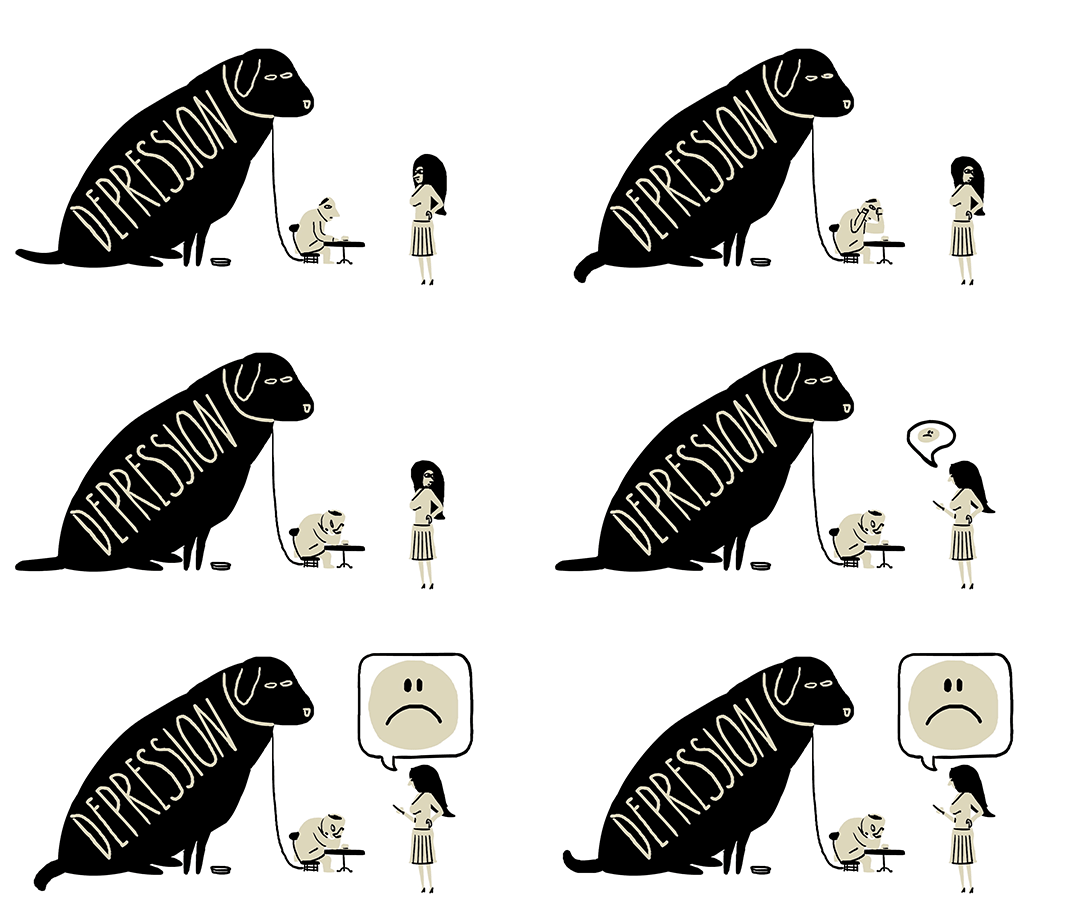
Depression is the leading cause of disability in the world; in the United States, close to ten percent of adults struggle with depression. But because it’s a mental illness, it can be a lot harder to understand than, say, high cholesterol.
One major source of confusion is the difference between having depression and just feeling depressed. Almost everyone feels down from time-to-time, but Clinical Depression is different. It’s a medical disorder, and it won’t go away just because you want it to. It lingers for at least two consecutive weeks and significantly interferes with one’s ability to work, play, or love. Chances are you know someone who suffers from depression. Here are some ways you can help.
1. Help find help: If you know someone struggling with depression, encourage them – gently – to seek out help. You might even offer to help with specific tasks, like looking up therapists in the area or making a list of questions to ask a doctor. To someone with depression, these first steps can seem insurmountable.
2. Be informed: If they feel guilty or ashamed, point out that depression is a medical condition just like asthma or diabetes. It’s not a weakness or a personality trait, and they shouldn’t expect themselves to “just get over it” any more than they could will themselves to get over a broken arm. The more you know about mental illness, the better able you are to understand what they are going through, and to support them.
3. Don’t downplay it: If you haven’t experienced depression yourself, avoid comparing it to times you’ve felt down – comparing what they’re experiencing to normal, temporary feelings of sadness can make them feel guilty for struggling.
4. Stamp out stigma: Even just talking about depression openly can help. For example, research shows that asking someone about suicidal thoughts actually reduces their suicide risk. Open conversations about mental illness help erode stigma, and make it easier for people to ask for help. And, the more patients seek treatment, the more scientists will learn about depression, and the better the treatments will get.
5. Continue the conversation: Because depression’s symptoms are intangible, it’s hard to know who might look fine, but is actually struggling. Just because your friend may seem fine one day, don’t assume that they’ve ‘gotten better’. Remain supportive.
That’s what you do with Depression, you mask the symptoms. The symptoms of Depression IS depression, it’s not a symptom of something else. It’s not like you go “oooh, I feel really sad” and then your arse falls off. The symptoms of Depression is depression. You take away the symptoms of Depression HALLOOOOO! you’re cured! But Tom [Cruise] was like “no, no, no Matt. Matt, these drugs Matt, these drugs they’re just a crutch, these drugs are just a crutch!” and I’m thinking “yes?”. THEY’RE A CRUTCH! You don’t walk up to a guy with one leg and say “hey pal, that crutch is just a crutch, THROW IT AWAY! Hop ya bastard! That crutch is masking the symptoms of your one leggedness”.
Craig Ferguson on Tom Cruise attacking Brooke Shields for using anti-depressants to fight Post-Partum Depression. (via themarriageofadeadblogsing)
I have always thought Craig Ferguson was a very smart man. It appears I was right.
While cleaning out my room I found a paper that my therapist gave me some time ago to deal with obsessive and intrusive thoughts. Sorry the paper is a little crinkled and stained, but I figured I’d post it in hopes that it will help someone like it helped me.
Here it is again with text for anyone who can’t see the picture
That thought isn’t helpful right now.
Now is not the time to think about it. I can think about it later.
This is irrational. I’m going to let it go.
I won’t argue with an irrational thought.
This is not an emergency. I can slow down and think clearly about what I need.
This feels threatening and urgent, but it really isn’t.
I don’t have to be perfect to be OK.
I don’t have to figure out this question. The best thing to do is just drop it.
It’s OK to make mistakes.
I already know from my past experiences that these fears are irrational.
I have to take risks in order to be free. I’m willing to take this risk.
It’s OK that I just had that thought/image, and it doesn’t mean anything. I don’t have to pay attention to it.
I’m ready to move on now.
I can handle being wrong.
I don’t have to suffer like this. I deserve to feel comfortable.
That’s not my responsibility.
That’s not my problem.
I’ve done the best I can.
It’s good practice to let go of this worry. I want to practice.
no offense but this is literally the most neurotypical thing i have ever seen
Uhhhh… no.
This is what they teach you in therapy to deal with BPD and general depression.
When I got out of the hospital after hurting myself a second time, I got put into intensive outpatient program for people being released from mental hospitals as a way to monitor and help transition them into getting them efficient long-term care.
This is something they stressed, especially for people with general depression. When you want to stay at home and hide in your bed, forcing yourself to do the opposite is what is helpful. For me, who struggles with self harm- “I want to really slice my arm up. The opposite would be to put lotion on my skin (or whatever would be better, like drawing on my skin) the opposite is the better decision.” It doesn’t always work because of course mental health isn’t that easy, but this is part of what’s called mindfulness (they say this all the time in therapy)
Being mindful of these is what puts you on the path to recovery. If you’re mindful, you are able to live in that moment and try your best to remember these better options.
I swear to god, I don’t get why some people on this website straight up reject good recovery help like this because either they a)have never been in therapy so don’t understand in context how to use these coping tactics. Or b)want to insist that all therapists and psych doctors are neurotypical and have zero idea what they are talking about. (Just so ya know, they teach this in DBT, the therapy used to help BPD. The psychologist who came up with DBT actually had BPD, so….a neurotypical women didn’t come up with this.)
*hugs and hugs and hugs* I am so glad I could help. And you are amazing, Nonnie. You really are. It is so hard to live with depression. And you are moving forward and fighting it and picking yourself up again when it knocks you down: you are so brave. You are so amazing.
1. All-or-nothing thinking: Looking at things in black-or-white categories, with no middle ground (“If I fall short of perfection, I’m a total failure.”)
2. Overgeneralization: Generalizing from a single negative experience, expecting it to hold true forever (“I didn’t get hired for the job. I’ll never get any job.”)
3. The mental filter: Focusing on the negatives while filtering out all the positives. Noticing the one thing that went wrong, rather than all the things that went right.
4. Diminishing the positive: Coming up with reasons why positive events don’t count (“I did well on the presentation, but that was just dumb luck.”)
5. Jumping to conclusions: Making negative interpretations without actual evidence. You act like a mind reader (“I can tell she secretly hates me.”) or a fortune teller (“I just know something terrible is going to happen.”)
6. Catastrophizing: Expecting the worst-case scenario to happen (“The pilot said we’re in for some turbulence. The plane’s going to crash!”)
7. Emotional reasoning: Believing that the way you feel reflects reality (“I feel frightened right now. That must mean I’m in real physical danger.”)
8. ‘Shoulds’ and ‘should-nots’: Holding yourself to a strict list of what you should and shouldn’t do and beating yourself up if you break any of the rule
9. Labeling: Labeling yourself based on mistakes and perceived shortcomings (“I’m a failure; an idiot; a loser.”)
10. Personalization: Assuming responsibility for things that are outside your control (“It’s my fault my son got in an accident. I should have warned him to drive carefully in the rain.”)
sometimes you say or do bad things while you’re in an awful mental place. sometimes you say things that are rude or uncalled for or manipulative. and i’m not going to hold that against you. mental illness is hard, and no one is perfect. but once you’re through that episode, you need to take steps to make amends. you need to apologize.
“i couldn’t help it, i was having a bad episode” is a justification, not an apology.
“i’m so fucking sorry, i fucked up, i don’t deserve to live, i should stop talking to anyone ever, i should die” is a second breakdown and a guilt trip. it is not an apology.
when you apologize, the focus should be on the person you hurt. “i’m sorry. i did something that was hurtful to you. even if i was having a rough time, you didn’t deserve to hear that,” is a better apology. if it was a small thing, you can leave it at that.
if you caused significant distress to the other person, this is a good time to talk about how you can minimize damage in the future. and again, even if it is tempting to say you should self-isolate and/or die, that is not a helpful suggestion. it will result in the person you’re talking to trying to talk you out of doing that, which makes your guilt the focus of the conversation instead of their hurt.
you deserve friendship, and you deserve support. but a supportive friend is not an emotional punching bag, and mental illness does not absolve you of responsibility for your actions. what you say during a mental breakdown doesn’t define you. how you deal with the aftermath though, says a lot.




 Aw Yiss