Wall sticker in Marlborough lesbian pub, Brighton.
i’m actually realizing this now
but the original poster said “queer power” and someone erased that and replaced it with “gay power”
real classy
#is this real
Well. I’m not exactly an expert at image analysis, but the bottom text in the first one looks much cleaner than the top text while the second one matches better. Also, the creases in the second one on the Q and U seem like the sort of detail that wouldn’t be faked. Finally, this actually matches up significantly better to “queer” politics than “gay” politics; it was always queers who advocated and took the front lines in direct action.
If you put the image in an editor or just view the full size of the first image, it becomes very obvious that the text on the bottom was added later: all of the vertical lines in every letter are pixel perfect straight lines. That is basically impossible with a photo of a poster that is both visibly at an angle, and has paper weathering and other distortion. Look at the verticals of the white text to compare. The only distortion of the text is the jpg artifacts we would expect in that level of contrast. There is no lighting on the pink text either, another highly suspicious trait.
Additionally, if you crop out the pink text in op and run an image search you get the second photo, as well as four or five other photos of the poster, all reading “queer power.”
With the pink text left in, however, the only version of the poster is this exact image, sourcing to op.
I want every single person who ever argued with me on That Queer Post to take a long, hard look at this. I have been told at least dozens of times that “nobody is saying you can’t identify as queer,” that I’m “ignoring history,” that they’re not trying to shift back to gay, etc.
Now, here’s this post, in which queer people are having their art defaced in order to rewrite their identity. Where they’re being forcibly rewritten as gay. Where history is being literally goddamn erased. It’s got three times the notes of That Queer Post, and as far as I can tell, @bifoxstiles is the first one to challenge this narrative. And I’m not gonna hold my breath on y’all to call out OP.
They’re literally stealing our history, rewriting it into a new version that excludes more than half of the community. And nobody’s challenging this. You’re too busy trying to shut down inclusive, egalitarian language.
Shame on every last one of you.
Uhhhh. That’s like a really famous poster, at least if you are over a certain age. I recognized it immediately.
Yeah. It… it never said ‘Gay Power’ originally. It said ‘Queer Power.’
What the actual fuck.
OKAY KIDS. HISTORY LESSON TIME.
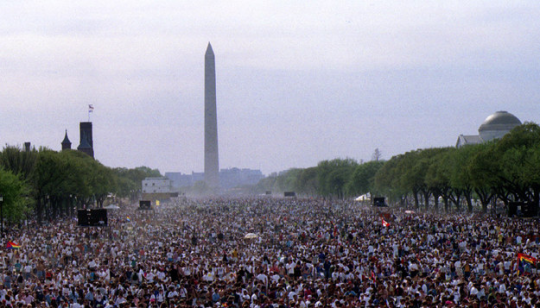
Ironically, just before this crossed my dash, Oxford University Press shared a link to a new archive of queer oral history. If not for Tumblr’s recent push to wipe “queer” from our collective memory, I wouldn’t have thought twice about OUP using the term. After all, it was chanted in pride and defiance when over a million of us participated in the 1993 March on Washington to demand an end to discrimination…
Video clip from that day: “We’ve come to Washington to show everyone that we’re here, we’re queer, and we’re not going anywhere!”
In the past year, I’ve seen some Tumblr members trying to suppress the word “queer,” just as people back then tried to suppress us. The excuse is that it’s sometimes used as a slur. But so is “gay.” In my 45 years, I have heard/seen “gay” used as an slur far more often.
At first, I tried to respect the fact that “queer” bothered some Tumblr users, even though it was painful for me to see queer-positive posts tagged “q slur.” But the more I thought about it, the more I realized that caving in to those asking us to drop the term “queer” would permit homophobic and/or transphobic sensibilities to define our identities.Do we have to drop “gay” now as well, or tag it “g slur”? Since when did we stop reclaiming these words as a matter of pride?
Isn’t this just the latest ploy of internalized homophobia/transphobia sneaking up on us?
Unfortunately, erasing “queer” from our vocabulary has hurtful real-world consequences.
Silencing “queer” silences many of those who fought, marched, rioted and died for your rights. It erases those of us who are queer but not gay: trans, intersex, nonbinary, lesbian, bisexual, aromantic, asexual people, and more (see why the term is so necessary?) Erasure/minimization of queer people is how we end up with disrespectful historical revisionism like that Stonewall movie. Or the Photoshopped poster above, rewriting our history with a lie.
And that’s the real kicker.
Erase “queer” from our vocabulary, and we erase future generations’ ability to learn about their past. How will they be able to find LBGTA+ history, if you teach them not to use one of the main keywords they need to search for to find it?
How much of our past and present community will be rendered invisible and their needs ignored (this article is really, REALLY worth a read), if those now lobbying against the term “queer” are successful?
Decades ago, when being out was taking a huge risk, we chanted, “We’re here, we’re queer, get used to it!” It would be a bitter irony if, even as mainstream society becomes “used to it,” as demonstrated from the Supreme Court to the bridge of the U.S.S.Enterprise, our own community becomes less “used to it.”
Think about the forces of prejudice who were trying to silence us when that “queer power” sign was made. Please don’t let them win.
18 years ago when I was coming out, y’all made the word “bisexual” so dirty that for years the only word I felt was accessible to me was “queer”, if I had any chance at having a community.
Queer was widely used at that point among LGBT+ people to refer to ourselves and our community, and while you’d look askance at a straight person using that word, it was most definitely acceptable to call another LGBT+ person queer.
And now y’all are telling me “Queer” isn’t an acceptable umbrella term to use and it just feels like another way you’re using subtle language policing to tell me that really the only people you want in your community are gold-star LG folks.
Those of us who like the word queer because it accurately reflects our misfit status are basically being told that this self-identifier is dirty and wrong, this is no longer the “queer community”, and the message yet again is that we don’t really belong.
I get it if someone doesn’t want to be called queer, and I would never call another person queer against their will but holy hell please stop acting like it’s common knowledge that queer can’t be used as an umbrella term for our community when it was for DECADES
“q-slur” is a very new concept, kids.
This is something
that’s completely overlooked, by the same people who fling the word
“ahistorical” at every viewpoint they disagree with.
When I first started
participating in any kind of LGBTQ+ stuff online (so, 10 years ago),
“queer” was by far the most common descriptor. It was pretty much
agreed it had been reclaimed enough to be safe (I mean, show me an
active slur that has academic disciplines named after it?) and people
seemed much more keen to explore the ambiguity the term offers,
rather than sticking with predefined categories. By “q-slur”
logic, we should’ve been much less accepting of it back then if we
simultaneously believe that LGBTQ+ rights are advancing over time,
but the opposite is true.
So I would say that the current
stigmatization of queer is based on two things: 1) reactionary
essentialism (seeing “queer” as too dangerous for the more
clear-cut categories), and 2) respectability politics.
Now by taking away
“queer”, we don’t have any other term that’s both catchy (no
version of the abbreviation is) and broad enough to actually be
inclusive. Gay is not an umbrella term. It always has a default
connotation that’s very specific. It only reminds me of all the time
I wasted on bad gay-only discourse when I was first questioning my
own identity, and for this reason it took ages to arrive at the
conclusion that I’m just attracted to multiple genders and also trans without dysphoria (because the other bullshit I had to
contend with was the truscum narrative of transness). So, gay is not a safe
term for me. It doesn’t describe me and if I used it, it would
actually misgender my own relationship. I’m not doing that for any of
you, sorry.
Do you know who the
majority of the people who still use “queer” are? Trans and MGA.
Yet again, we have a political line that privileges cis LG people who are fine with binary categories
over the most routinely erased parts of the community. Of course.
This, I imagine, is also
why so many bi/pan and trans/nonbinary people aren’t against aces
being included. Chances are most of us, at least those who are 25+ or so,
have experiences like this, with either being actively policed out
or just unable to find the right identifiers for ages because of the
stigma and general ignorance surrounding them.
And now you’re
telling us we HAVE TO use gay, which isn’t a functional umbrella
term, because queer suddenly isn’t acceptable based on this new logic?
Do you even hear yourselves?
–
“But!” I can already hear the gatekeepers protest, “This all
relies on a bunch of personal anecdotes!”
In which case,
buddy, I have bad news for you about the vast majority of all modern
LGBTQ+ history.
I first came upon Queer as both an umbrella term and a field of academic study. This was in the early 90s. There were queer studies, queer histories, “queering” of the text, queer theory…
And Queer, more so than other words, felt inclusive of people who, at the time, referred to themselves as “genderqueer” as well as people outside the binary, as well as bisexuals, who couldn’t claim gay or lesbian.
It was, at the time, being reclaimed at a time when all the words were being used as slurs, so there was a real reason to reclaim them.
I’ve problem with using words that people are comfortable using, but not at the cost of erasing parts of our history.
I guess now is the
time we’re hitting New Essentialism and Respectability Politics 2.0
from people who aren’t old enough to remember any of this.
Yeah, that’s something a lot of folks in the younger generation don’t get.
When you campaign against words like “queer”, to those of us in the older generations, what it looks like you’re doing is trying to roll the nomenclature back to the bad old days when cisgender gay men were treated as the only “real” members of the community, and everybody else was lumped together as this peripheral pack of weirdos who were expected to be slobberingly grateful to their betters just to be acknowledged at all.
Hell, I clearly recall a time when the leaders of mainstream gay rights activism would routinely castigate even lesbians as parasites and invaders – and be applauded for doing so. It’s difficult to overstate just how deep it went.
And, like, that wasn’t all that long ago – I’m only 33 and I’m old enough to remember that horseshit.
I could probably hit up ye olde googleheim for this but I wonder how they chose the order for LGBTQIA like … what type of alphabet
have you seen the white gays reorganize it to have the G first lmao
no but not like it would change anything anyway that’s basically how it is
This is something I know a lot about, so pardon me for this…
Prior to the Stonewall Riots, even activist groups tended to default toward some variation of the word “homosexual” in their titles. Until the slang term “gay” began to catch on in the 60s.
So in the 70s, it was simply the “gay liberation movement” – at a time “gay” (sort of) functioned as a catchall for all sexual and gender minorities. It was thought of as an umbrella term, even if it wasn’t.
As time passed, because lesbians felt that they were (and they actually were) excluded in many cases from the movement, “gay and lesbian” became commonplace throughout the 80s and into the 90s.
“Gay and lesbian” is still on the founding documents of many organizations that sprang up in the post-AIDS-crisis era of Human Rights Campaign-style activism that was primarily concerned with visibility politics and increasingly focused on the concerns of white, middle-to-upper class assimilationist queers (the “we’re your doctor, your lawyer, your neighbor, your cousin, and we’re just like you” crowd). Examples:
GLAAD (Gay and lesbian anti-defamation league)
The Task Force (founded as National Gay Task Force, then the National Gay and Lesbian Task Force in 1985. They started going by just “The Task Force” in the early 2000s, before officially changing their name to National LGBTQ Task Force only in 2014)
But because of this assimilationist trend in the political movement and the style of activism with the most visibility, people who felt excluded began pushing back. Some advocated for better representation of bisexual and transgender people, hence GLBT began to get added to mission statements. Some, particularly nonwhite communities, rejected the terms altogether, proliferating terms like “Men who have sex with men”/MSM, and “same gender loving”/SGL or even the problematic “Down Low” (DL) into certain activist spaces. As GLBT became common in the late 90s, more groups started pushing for inclusion: Intersex (I), Asexuals (A), Questioning (Q), Queer (Q), Two Spirit (TS), etc.
Meanwhile, some folks thought we should avoid the alphabet soup altogether and run with Queer. An umbrella term that would also encompass things like polyamory, fetishism/kink, etc., without excluding anyone.
Groups coming into play around this time tried to avoid wading into the debate altogether, thus we have organizations like “Equal Rights Nevada” “Equality Utah” “Empire State Pride Agenda” “MassEquality” “Out & Equal” and “Pride at Work.”
It was in the early 2000s that feminist and lesbian leaders convinced people to switch from GLBT to LGBT. Queer never quite caught on for activist circles and organizations, in part because it was too broad, and sometimes you need a little more specificity in your mission statement… otherwise you run the risk of getting hijacked by cisgender, straight allies intent on pushing an oppression narrative about how they’re discriminated against for liking to get spanked. But, probably more importantly, a lot of people of an aging generation had extremely bad connotations around the word and weren’t interested in reclaiming it. Anyone over the current age of 45 or so probably grew up being bullied under the word queer. Queer was too controversial for risk-averse organizations depending on the fundraising support of older gay men and women.
So by the time I was in college (late 90s), GLB or GLBT was the default for most.
I remember the debate around changing GLBT to LGBT (or even TBLG) very well. I worked in the queer press at the time (2000-2005). It made a lot of people very mad. It still makes some people mad. But the idea was to emphasize that gay men were not primary. It was a feminist thing. Sadly, the argument for TBLG (which argued that we name them in order of most oppressed and/or least visible) never really caught on beyond a few academics and some hardcore activists.
We made the editorial decision in 2001 to officially switch to LGBT unless quoting someone or as part of a proper name (e.g. the title of an organization). So did many other papers. GLAAD pushed this standard into the mainstream press. It caught on.
Most groups/editorial boards/journalists/activists put their foot down around the lengthy alphabet soup stopping at 4 – although Q, I and A are sometimes added depending on the group. Whether A stands for asexual or ally and whether Q stands for queer or questioning all depends on the group in question.
As far as I can tell, LGBT is the settled default. I’m not aware of any concentrated political push to move on and change it now, at least not like there was in the late 90s and early 2000s. Although it could happen. I would welcome it. Language, and how we frame our movement, must evolve.
Sorry, I know I wasn’t asked, but I wanted to throw some history out there.
I’ve been trying to think of a good term for the “weepy movies about tragic queer people aimed at straight audiences” subgenre, and I think I’ve got it:
dead gays for the straight gaze
eh? eh??
queers die for the straight eye
SO YOOOO who wants to learn why this is a thing because the history is actually really fascinating and ties into some of my favorite shit ever?
Okay, so like, back in the mid-twentieth century, when being queer was still totally a crime everywhere in the United States, queer writers started working in pulp fiction–starting with Vin Packer (she is awesome)–and writing pulps to tell our stories.
So one day over lunch, her editor asks her, “Hey, Vin, what’s the story you most want to write?”
And she goes, “Well, I’d like to write a love story about lesbians because I’m, you know, gay.”
He says, “Hey, that’s awesome, I will publish it. One thing, though, the homosexuality has to end badly and the main character has to realize she was never gay in the first place. We can’t seem to support homosexuality. I don’t actually think that’s cool, but the government will literally seize our book shipments and destroy them on the basis of the books being ‘obscene’ if you don’t, so if we want this story actually out there, and not burning in a bonfire somewhere, it’s what you gotta do.”
So Vin goes home and writes Spring Fire, the book that launched the entire lesbian pulp genre. And while one character ends up in an insane asylum and the other ends up realizing she never loved her at all, it’s massively successful, and queer women everywhere snap it up and celebrate quietly in their closets across the nation because HOLY SHIT THERE’S A BOOK ABOUT ME? I’M NOT ALONE and it starts a huge new genre.
But: every publisher is subject to those same government censorship rules, so every story has to end unhappily for the queer characters, or else the book will never see the light of day. So, even though lesbian pulp helps solidify the queer civil rights movement, it’s having to do so subversively or else it’ll end up on the chopping block.
So blah blah blah, this goes on for about twentyyears, until finally in the seventies the censorship laws get relaxed, and people can actually start queer publishing houses! Yay! But the lesbian pulps, in the form they’d been known previously, basically start dying out.
MEANWHILE, OVER IN JAPAN! Yuri, or the “girls love” genre in manga, starts to emerge in the 1970s, and even starts dealing with trans characters in the stories. But, because of the same social mores that helped limit American lesbian pulp, the stories in Japan similarly must end in tragedy or else bad shit will go down for the authors and their books. Once more: tragic ends are the only way to see these stories published rather than destroyed.
The very first really successful yuri story has a younger, naive girl falling into a relationship with an older, more sophisticated girl, but the older girl ends up dying in the end, and subsequent artists/writers repeated the formula until it started getting subverted in the 1990s–again, twenty years later.
And to begin with cinema followed basically the same path as both lesbian pulps and yuri: when homosexuality is completely unacceptable in society, characters die or their stories otherwise end in tragedy, just to get the movies made, and a few come along to subvert that as things evolve.
But unlike the books and manga before them, even though queer people have become sightly more openly accepted, movies are stuck in a loop. See, pulps and yuri are considered pretty disposable, so they were allowed to evolve basically unfettered by concerns of being artistic or important enough to justify their existence, but film is considered art, and especially in snooty film critic circles, tragedy=art.
Since we, in the Western world, put films given Oscar nods on a pedestal, and Oscar nods go to critical darlings rather than boisterous blockbusters (the film equivalent of pulps, basically), and critics loooove their tragedy porn, filmmakers create queer stories that are tragic and ~beautiful~ that win awards that then inspire more queer stories that are tragic and ~beautiful~ until the market is oversaturated with this bullshit.
The Crying Game? Critical darling, tragic trans character.
Brokeback Mountain? Critical darling, tragic queer (? not totally sure if they’d consider themselves gay or bi, tbh?) characters.
And so on and so on VOILA, we now have a whole genre of tragedy porn for straight people, that started out as validation for us and sometimes even manages to slip some more through the cracks occasionally, but got co-opted by pretentious ~literary~ types. While tragic ends made these stories more acceptable to begin with, and in the mid-to-late nineties that started getting subverted a little bit (Chasing Amy, But I’m a Cheerleader), eventually that became the point, as more straight audiences started consuming these narratives and got all attached to the feels they got from the ~beauty of our pain~.


 Aw Yiss