culturalrebel:
ratherembarrassing:
k-loulee:
fozmeadows:
hollowedskin:
derinthemadscientist:
languageoclock:
deflare:
penfairy:
Throwback to the time my poor German teacher had to explain the concept of formal and informal pronouns to a class full of Australians and everyone was scandalised and loudly complained “why can’t I treat everyone the same?” “I don’t want to be a Sie!” “but being friendly is respectful!” “wouldn’t using ‘du’ just show I like them?” until one guy conceded “I suppose maybe I’d use Sie with someone like the prime minister, if he weren’t such a cunt” and my teacher ended up with her head in her hands saying “you are all banned from using du until I can trust you”
God help Japanese teachers in Australia.
if this isnt an accurate representation of australia idk what is
Australia’s reverse-formality respect culture is fascinating. We don’t even really think about it until we try to communicate or learn about another culture and the rules that are pretty standard for most of the world just feel so wrong. I went to America this one time and I kept automatically thinking that strangers using ‘sir’ and ‘ma’am’ were sassing me.
Australians could not be trusted with a language with ingrained tiers of formal address. The most formal forms would immediately become synonyms for ‘go fuck yourself’ and if you weren’t using the most informal version possible within three sentences of meeting someone they’d take it to mean you hated them.
100% true.
the difference between “‘scuse me” and “excuse me” is a fistfight
See also: the Australian habit of insulting people by way of showing affection, which other English-speakers also do, but not in a context where deescalating the spoken invective actively increases the degree of offence intended, particularly if you’ve just been affectionately-insulting with someone else.
By which I mean: if you’ve just called your best mate an absolute dickhead, you can’t then call a hated politician something that’s (technically) worse, like a total fuckwit, because that would imply either that you were really insulting your mate or that you like the politician. Instead, you have to use a milder epithet, like bastard, to convey your seething hatred for the second person. But if your opening conversational gambit is slagging someone off, then it’s acceptable to go big (”The PM’s a total cockstain!”) at the outset.
Also note that different modifiers radically change the meaning of particular insults. Case in point: calling someone a fuckin’ cunt is a deadly insult, calling someone a mad cunt is a compliment, and calling someone a fuckin’ mad cunt means you’re literally in awe of them. Because STRAYA.
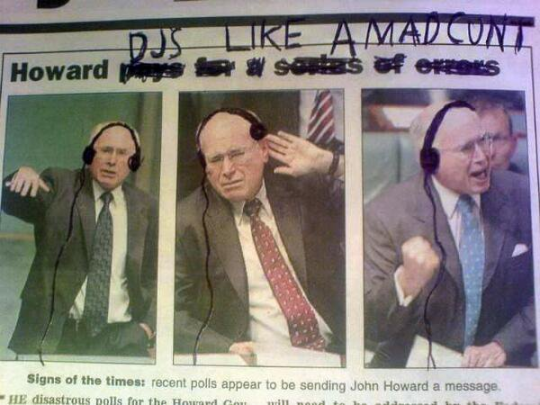
case in point: the ‘Howard DJs like a mad cunt’ meme.
I recommend this bloody good article by Mark Di Stefano of Buzzfeed Australia about the origin of John Howard’s DJ skills: We Found The Guy Behind Australia’s Greatest Ever Meme.
extra pro level aussie: calling a stranger mate. depending on context, they’re either about to become your new best friend, or someone’s about to get king hit.
@determamfidd your country fascinates, confuses and frightens me in equal measure
seriously my darlingest @culturalrebel, if Strayans had informal and informal pronouns, we would only use the formal ones to indicate how much we HATED the person we were addressing. We’d manipulate it to say ‘THIS PERSON IS SO FAR UP THEMSELVES THEY NEED A HARD HAT AND A TORCH.’
THE cardinal Australian sin is to be ‘up yourself’. To be ‘up yourself’ is to be an arrogant person who thinks and acts as though they are better than others.
‘Bitch’ is either a killing insult or a term of affection. Same with ‘bastard’ and ‘dickhead’. ‘Wanker, however,’ is ALWAYS an insult. We use ‘wanker’ for the same sort of thing as ‘up themselves’ – a wanker here doesn’t just mean an annoying person, it also means someone who elevates themselves above others, insists on preferential treatment, etc.
And yeah, if someone you’ve just met calls you ‘mate’ in a particular tone of voice, you’re about to get punched.




 Aw Yiss