Comparison is the thief of joy. By wishing you are more like your colleagues, by watching their successes and dwelling on your own failures, you are doing nothing to better yourself.
Vulnerability is necessary. It’s scary. You’re going to have to take a leap. But it’ll be worth it.
Don’t make excuses.
Failing an endeavor does not make you a failure. “Ever tried? Ever failed? No matter. Try again. Fail again. Fail better.” -Samuel Beckett
You are only as good as you dare to be bad.
Bloom where you are planted.
Read more plays, listen to more musicals. You can’t be a competent and intelligent performer without knowing your history. People will want to talk to you about these composers and these playwrights, and if you are able to have intelligent conversations about them, you’re ahead of the game.
Don’t dwell. On the part you didn’t get, on the note you missed, on failure, on success. Don’t dwell.
Your body is your instrument. Take care of it.
Work while they sleep. Or party. Keep working while the rest think they are done. The work is never done. Never let it be done. “The heights by great men reached and kept were not attained by sudden flight, but they, while their companions slept, were toiling upward in the night.” Henry Wadsworth Longfellow
Talent is not talent. ”Talent is an amalgam of high sensitivity, easy vulnerability, high sensory equipment, a vivid imagination , a grip on reality, the desire to communicate one’s own experience and sensations, and a desire to make oneself heard and seen.” -Uta Hagen
Don’t be the second best Meryl Streep, be the best you.
Acting is not learned from books alone.
Know yourself, but don’t overdefine yourself. People change, so can you. So know who you are, but be ready for your world to completely change at any time.
If you try to please everybody, you’ll lose yourself. Making yourself proud is more important than making your professor proud, or making your colleagues proud.
Raise. The. Stakes.
Everything is okay until you ask permission. Follow those impulses. You’ll figure out if it works or not.
Listen as you speak.
Keep your energy always moving forward.
Serve the text. We all want to make wonderfully inventive decisions about characters, but be sure it’s always in service to the text, not service to yourself.
Find your objective.
Build the role on truth, not stereotype.
Comb away all the extra. We’re not striving to complicate things, but rather to simplify things.
Stay in a state of gentle curiosity.
As long as it’s honest and true, it’s perfect.
Play actions. You cannot play attitudes or feelings, only actions.
Before you learn, unlearn. Bad habits die hard.
Particularize. What kind of room are you in? Where’s the window? What does the door look like? The audience won’t know all the details you create, but the details will flesh out each word.
Let all of the play inform your monologue, not just the scene before it.
Live truthfully under imaginary circumstances.
The magic “if.” “If” acts as a lever to lift us out of the world of actuality into the realm of imagination.
Research. Research to the point that you know the time period, the lifestyle, the history better than you know your own. Let it inform your character.
Live the part every moment you are playing it, every time.
Nothing is allowed to be general.
Fill the pause. And earn the pause. What did you do to earn that pause in your lines, why are you pausing, and what are you filling it with? What is the purpose?
In order to hold something back, you must have something to hold.
Context is critical. What do you need in this particular moment?
Use your memories. ”Time is a splendid filter for our remembered feelings—besides, it is a great artist. It not only purifies, it also transmutes even painfully realistic memories into poetry.” -Stanislavski
But torturing yourself for an emotional reaction in a scene is not worth it. Be gentle with yourself, because you can drive yourself mad if you aren’t careful.
Leave the work at home. Work hard at home, experience honestly in the room.
Do not run for the sake of running, or suffer for the sake of suffering.
Keep your obstacles in mind. What’s the best/worst that could happen?
Playwrights write plays about the most important days of people’s lives.
NECESSARY STUFF:
The OP above gave full permission to use their post as a launchpad for this
commentary, so please don’t mistake this as either endorsement or criticism, and please do not mistake it as a group invitation to attack. I’ve
written about this phenomenon in the Rowling fandom before and this gives me another
excuse. Plus, as someone who tried to join
a fandom via this writing strategy and failed, I think I can contribute some thought
fodder on the issue of content sameness.
I’m bout to drop an essay, hobbits. This essay isn’t,
however, a critique. This is a non-evaluative observation and a writing theory. And, finally, an open
question to fellow fic writers.
BASE OBSERVATION: The
dominant writing styles in book-based fandoms mirror and pay homage to the style
of the original author.
WOW, holy heck this is a beautiful theory, and one I agree with absolutely.
I’ve noticed that stylistic imitation seems to happen more often in fandoms where the canon is heavily book-based, such as Harry Potter or Tolkien. In Avengers fandom, though, the writing was far more varied in style. I think this is bc it is mostly a visual canon (movies/comics) and people can explore different avenues of capturing it.
I’ve seen the argument made that folks enjoy the atmosphere and language of the books, and so seek out works that remind them of it.
I’ve mentioned before that I set out in Sansukh to try and channel Tolkien’s style, and so yeah, that’s a totally spot-on observation to make. Really pleased that you feel I did so, too 🙂 Thanks!
The main aim though, for me, was to capture the ‘feel’ of Tolkien’s work whilst also making it a little more accessible and fluid, bc the man could get so dense and impenetrable – less so in The Hobbit, absolutely, but LOTR can be slow and a bit arduous at times. So, I’ve stepped right away from some of his more idiosyncratic writing quirks, such as the gigantic block of descriptive text, slipping into ‘high style’ with the ‘thees and thous’ every so often – this seems to happen mostly in emotional moments – and the heroic declamations, as some examples. (Aragorn has SO MANY DECLAMATIONS)
Something else I tried to implement as the story progresses – I add more and more of my own stylistic interpretation, rather than Tolkien’s. I try to, in effect, transition away from a purely faithful ‘Tolkienesque’ style, to something sliiiiiightly more modern and blended – and far, far more emotional.
I do enjoy his dialogue syntax very much, though – particularly for the hobbits!
When it comes to your three choices detailed, I definitely fell into the first category:
Faithfully reconstruct and largely adhere to Tolkien’s style. (This is the choice most Big Fic writers in any book-based fandom make. On the downside, this limitation can feel creatively constricting. It should, however, be mentioned that some writers find this strategy ultimately increases their creativity – the stylistic constraints demand they make more daring creative choices in other realms, such as plot or characterization.)
I ABSOLUTELY find that constraints make me more creative! Well, 90 times out of 100, I do, hahaha. I enjoy writing myself into a corner and then finding the way out – it is something I’ve done again and again, it forces me to up my game. Further, the restraints placed on me by following an existing timeline/story forced me to get even more inventive! I knew that readers weren’t interested in reading the same story all over again (I mean, they could just read the book instead, sooo….) and thus I had to find new ways and new angles from which to view it, and new language with which to tell it. I am a lot fonder of simile and metaphor than Tolkien, that is for sure
In regard to your supporting/opposing notes: I would agree once again. I also personally find them irritating, both the patriarchal cultural concepts, and the feminisation of Bilbo. Both of these are aspects I have striven to eschew. I will have only succeeded imperfectly, I know, bc i am a fallible meatbag, but I hope I have managed to a greater rather than a lesser degree.
Addressing the open question now: god, I have no idea. I obviously plumped for your first option for the big fic! I have smaller Tolkien works (The Long Road, or Yours Faithfully, for instance) in which I have experimented with a very different authorial style and made very different syntactic choices. They didn’t ever reach the same sort of readership as the more Tolkien-flavoured fics. So, I don’t know, but I would be thrilled to hear more of your thoughts on the matter. Thank you so much for an engaging and thoughtful read!
*valid does not mean healthy, or good, or to be privileged above common sense and kindness
A distinction for anyone who is young and hasn’t figured this out yet:
You are allowed to have whatever emotions you want. No one can control your emotions. Emotions are healthy responses to things.
You are not allowed to have behaviors that are harmful just because you have certain emotions. Your behaviors are what you can control, and they are far easier to control than your emotions.
You can be jealous about someone or their talents until you turn green, but it is harmful to yourself and to that person if you try to sabotage them because of it. You can be so angry you can literally feel your temperature rise, but this does not give you permission to rage at others.
Your emotions are valid. They are always valid. You are a person of value. However, you behaviors are not always justified just because of those emotions. You may not be able to control you emotions, but you can certainly control your behaviors.
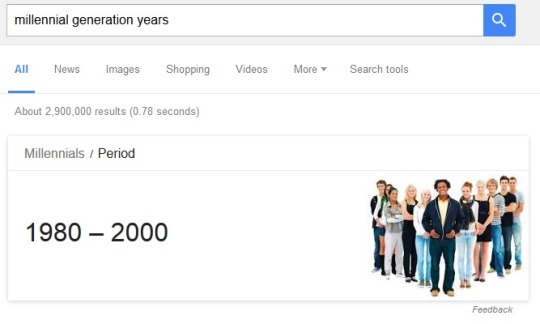
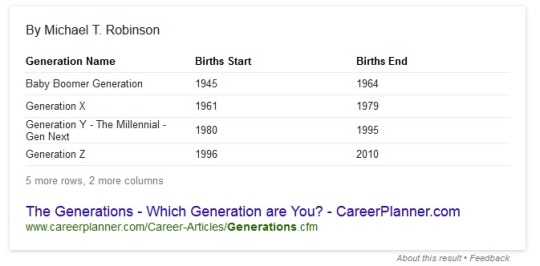
That the oldest of the Millennials are 36 years old.
In fact, some charts have them ending as early as 1995.
So if you were born between ‘95 and 2000 you could be either a Millennial or Gen Z.
I think the point I’m trying to make here is that most people talk about Millennials as if they’re all clueless teenagers when in reality they’re likely between the ages of 20-36.
Millennials are generally young adults suffering from a failing economy and a failed educational system, being portrayed as clueless children by the people who broke the economy and the educational system.
Reblogging for that shit ^^^
Thank you for this.
tfw when you’re an early Millennial (I’m 34) and older folks start bitching to you about ‘those device-obsessed Millennials, lazy entitled blah blah blaaaaah’ [insert tired awful stereotypes and lies here]…
…and when you say ‘I’m a Millennial’, the blood drains from their face and you watch them backtrack and mitigate their shitty words as fast as fucking lightning like
When a toxic person can no longer control you, they will try to control how others see you. This misinformation will feel unfair, but stay above it, trusting that other people will eventually see the truth just like you did.
Fake it ‘til you make it is honestly some of the best advice I’ve ever been given in terms of mental illness.
It’s one thing to feel in your bones that you’re an absolute failure that doesn’t deserve life or love and acting like it, and a whole different thing to not.
For one, telling yourself one morning “I’m gonna pretend to be happy today” or “I’m gonna pretend to be proud of myself today” will almost always end with you having a pretty decent day. (Doesn’t last longer than a day, believe you me, and one small bad thing can shatter that illusion like a cement block through glass)
Second, it starts to trick your brain into thinking certain ways. Usually. Just like you can keep telling yourself you don’t matter until you believe it, you can keep telling yourself you matter until you believe it.
And if you don’t? If you honest to god think you don’t matter, that your life and what you do has no meaning in this world, well, what’s the harm in acting like it does to others? Best case, you convince them that you’re some self-confident godbeing. Worst case (but also funniest case), you convince them to despise you for being so proud of yourself, never knowing that you in fact can’t stand yourself as much as they do.
Fake it til you make it, dudes. Be a hotshot in your own head if you gotta. Reblog your stuff ten billion times and scream like a little kid when the smallest of good things happen. Makes the black dog in your head cower and back off. Be confident even if you don’t believe it.
Honestly this is the best advice ever. About a year ago, I decided to just fake self confidence really really hard, and the results? People started to assume I was more confident and outgoing (in particular my boss but also my parents), things became easier to do because fake-confident-me wouldn’t have a hard time doing anything. It doesn’t work all the time, but seriously this helps.
In particular, I hated how I looked. I despised my appearance, I’d never take a selfie, I’d avoid mirrors, wear a full face of makeup every day, wear boring clothes that would fade into the background, which of course all came back to thinking I wasn’t worthwhile. Fake-confident-me wouldn’t have any of that. Sure, I still do some of those things, like wear makeup all the time, and there are still moments where I can’t stand my body. But man oh man, fake-confident-me has made being real-me a hell of a lot easier.
I’ve met people that I last saw years ago and often times I’ll get comments like ‘you’re so different’ or ‘you look so much better’ and I will always tell them to fake it tell they make it. Fake it guys. Fake it so goddamn hard that it slowly becomes real
The responses are direct, gentle, and very good. It has sections for family, friends, coworkers, and self.
Please read it, please spread the link, please keep this link around as reference. Everyone needs to see this. It is very important that we arm ourselves that we may be better able to address the casual hateful speech many of us are likely to encounter.
One of the most effective tools at our disposal is protecting the area around us, and making sure that things like this said within earshot of us will not go unchallenged.




 Aw Yiss