In my treks over the internet, I have seen various people (mostly social justice people) worrying that they are somehow harming Real disabled people if they use a wheelchair if they can still walk a little or use stim toys or these nifty color communication badges if they aren’t autistic. Similarly, I have seen various people (mostly anti-social-justice people) who believe that Fake Disabled People are running around pretending to be disabled and using color communication badges and wheelchairs and so on, and this hurts disabled people somehow (they have never quite specified how).
This is completely fucking wrong.
In universal design, there’s something called the curb cut effect. Basically, things intended to benefit people with disabilities wind up benefiting everyone. Curb cuts, which are intended for wheelchair users to be able to get on sidewalks, help bicyclists, parents with strollers, delivery people, and a dozen other nondisabled groups. Similarly, closed captioning, which was originally meant to benefit Deaf people, helps people who have trouble with auditory information processing (hi!), people who like talking during films, and people trying to watch TV in noisy bars.
The curb cut effect is accessibility activists’ secret weapon. You see, people don’t generally want to accommodate disabled people any more than they have to. Accommodating disabled people is a pain in the neck, and disabled people are generally a small and relatively powerless group with limited ability to complain. However, if any TV network tries to remove closed captioning, they won’t just have to put up with complaints from Deaf people. They will have to put up with complaints from everyone who has ever tried to watch TV in a noisy bar. The latter is far more likely to strike fear in the TV executive’s heart.
Furthermore, pretty much anything that’s limited to disabled people only has to have some sort of process for figuring out who’s disabled. This presents numerous issues. Many disabled people don’t know they’re disabled. (Raise your hand if you’ve had a conversation with someone who thinks that ADD or depression isn’t real because everyone acts like that, right?) Many disabled people struggle with feeling like “fakers” and won’t ask for accommodations that they need. Many disabled people who do know they’re disabled can’t prove it: healthcare access is often limited for poor people, people of color, trans people, and so on; navigating bureaucracy requires skills like being able to talk to people, show up places at a scheduled time, and do things that you intended to do, that many mental illnesses and developmental disabilities make difficult. Every time you say “this is for disabled people only”– whether by limiting it to disabled people institutionally or by criticizing people who do it and whom you don’t think are disabled enough– a lot of disabled people don’t get access to it.
Sometimes this is a cost worth paying. For instance, we can’t let everyone bring their dogs into every public space, because service dogs have to be specially trained to not be disruptive in stressful situations. This training is expensive but service dogs are usually free, meaning that the number of service dogs available is limited, so we can’t have service dogs available to everyone who wants one. In this case, the alternatives are much worse and the cost is worth paying. But the cost is still a cost.
And notice that the people who decide who gets service dogs are the client’s medical professionals, not random strangers. It is never okay for random strangers to decide if someone is disabled enough for an accommodation. For instance, some store owners will only let service dogs in if they think the person is “really” disabled. This is wrong (and also illegal by the Americans with Disabilities Act). Other people will make fun of wheelchair users who can stand up. It is a major violation of privacy to expect random strangers to disclose their private medical history to you. You are far more likely to be harassing an actually disabled person to be criticizing a nondisabled person. And even if the person is nondisabled… who cares? Nondisabled people using wheelchairs does nothing but create a larger pro-wheelchair demographic, which benefits disabled wheelchair users. There is no call to be the Disability Police.
For a specific example, consider one of my friends, who started flapping his hands when he was happy because he thought it was adorable and later found out that flapping your hands when happy is a common symptom of autism. He freaked out, worrying that he was appropriating autism somehow. However (as I told him at the time) actually nonautistics flapping their hands works out great for autistic people. A culture in which the default reaction to happy hand-flapping is “ohmigod, adorable” rather than “you freak” is a culture in which autistic people do not have to waste energy suppressing their natural ways of moving. And because he’s nonautistic, it’s much easier for him to explain to people who dislike hand-flapping why it is wrong to do so, which helps to create a more welcoming environment for autistic people.
Similarly, I’m nonautistic, but I do flap my hands when I’m experiencing intense emotion. Unlike many autistic people, it is possible for me to stop. Think about it like not smiling when you’re happy: it’s possible for most people to do so (especially if they get mocked for being weird every time they smile) but instead of being fully present in the moment you’d have to be continually conscious of your facial expression lest your lip twitch when you’re not thinking about it. If we say “you must be This Autistic to flap”, then I still have to police what my hands are doing, which goes against the whole point. But if we say “everyone gets to express happiness in the way most natural to them, unless you express happiness by punching people in the face or something”, then everyone gets to express happiness in the way most natural to them (yay!) and we have lots of people invested in creating a culture where that stays true (yay!).
In conclusion: if an accommodation helps you and you can get it without proving you’re disabled (i.e. as you must to get a service dog), you should use it. If using a wheelchair helps you move faster and farther than you would otherwise, use a wheelchair. If stimming makes you happy, stim. If those nifty communication cards help you express your communication preferences (and they are available at whatever event you’re at, which seriously why is that not every event, they are so cool), use them. And it is wrong to disability police people. If someone does not seem disabled enough to use an accommodation to you, then you should be quiet and mind your own business instead of harassing them about it. In the vast majority of cases, nondisabled and less disabled people using something is helpful to more severely disabled people, and when it is not, it is the job of medical professionals to decide, not you.
Every time you say “this is for disabled people only”– whether by limiting it to disabled people institutionally or by criticizing people who do it and whom you don’t think are disabled enough– a lot of disabled people don’t get access to it.
this is such a good post.
Female staffers adopted a meeting strategy they called “amplification”: When a woman made a key point, other women would repeat it, giving credit to its author. This forced the men in the room to recognize the contribution — and denied them the chance to claim the idea as their own.
“We just started doing it, and made a purpose of doing it. It was an everyday thing,” said one former Obama aide who requested anonymity to speak frankly. Obama noticed, she and others said, and began calling more often on women and junior aides.
When a toxic person can no longer control you, they will try to control how others see you. This misinformation will feel unfair, but stay above it, trusting that other people will eventually see the truth just like you did.
Fun fact: Gender and Sex are both human made constructs designed to describe natural phenomenon but are not actually based in any biological reality. Much like the concept of “species”, it’s a model, and no model is an actuality – then it would not be a model, it would be a fact.
In truth sexual characteristics are diverse and varied and do not always match up with sex chromosomes; also, a sexual “binary” of sorts is not constant amongst all living things, and most organisms have other systems of reproduction.
Furthermore, gender is the suite of societally-defined social roles and behavioral characteristics that is typically assigned based on the externally perceived sex of a child; and does not actually have anything to do with biology – even less so than sex. Even though it is assigned based on this externally perceived sex, a person’s gender does not have to remain with the one assigned; much as we don’t determine people’s careers based on who their parents were anymore, your birth has no limitation on who you are and what gender identity you construct for yourself. Since it is a societally defined construct, people can and do construct more than the two traditional ones, and all are valid.
Just because you cannot handle your societally constructed worldview surrounding sex, gender, and genetics being dismantled by sociology & biology itself doesn’t mean, additionally, that you have the right to make other people feel unsafe and uncomfortable – in short, that you have the right to remove people from moral consideration – simply because you don’t like having your world view being dismantled. Believe it or not, the complexities of human behavior & the diversity of sex and reproduction in life cannot all be covered in a simple high school biology class.
So next time you want to say “didn’t you pass biology” remember: a biology PhD student, who graduated from the University of Notre Dame with an actual degree in Biological Sciences, has reminded you that you’re wrong.
There are more than two genders.
The end.
Sex is biological tough… It’s not a social construct… It’s not time, racism etc. It’s a physics attribute.
Why are you trying to argue with someone who said species is a constructed model and not a fact? You’re not going to change someone’s mind when they’re that far down the rabbit hole
Me: Spends 6 years intensely studying biological science and evolution at two major universities with widespread academic acclaim, earning honors and high GPAs and am currently working on a PhD in the subject of biodiversity and evolution
You: Somehow thinks they know more because you took a couple of classes
Lol
…Buddy. Buddy. Dude. I really don’t think you want to open this can of worms.
I mean, I know that in school they teach you a very clean, concise, definitive way of doing things and you’ve probably learnt something like the definition of a species is a population of organisms that are able to reproduce and produce viable offspring, or something. But I mean literally anyone who has done even undergrad biology can tell you that that statement is incredibly reductive and incredibly controversial in the scientific community [1][2]. In fact, you probably don’t even need a background in biology to spot the obvious flaw in the logic there, which is the fact that organisms classified as different species do reproduce and produce viable offspring. Quite a lot, actually. Lions and tigers (Panthera leo and P. tigris), coyotes and grey wolves (Canis latrans and C. lupus)… In fact, there’s even a word for new species arising through hybridisation between existing species – hybrid speciation [3]. The great skua (Stercorarius skua) is believed to be an example of this in animals [4], and another interesting one that may be pretty much hybrid speciation in action (though not nearly anything that can be called a new distinct species yet) is the so-called “Eastern coyote”, a population of wild coyotes in the eastern US that are mixed with grey wolf and domestic dog, and can contain as much as 40% non-coyote DNA [5].
And, in fact, the ability of two organisms to reproduce and produce viable offspring actually has very little with how we choose to classify them, because evolutionary and genetic relationships are rarely that simple. For example, some species that are the same genus – e.g. horses (Equus ferus) and donkeys (Equus africanus) can interbreed, but their offspring are usually sterile [6], while other species that are different genera to each other can interbreed to produce intergeneric hybrids, some of which are even fertile (for example crosses between false killer whales (Pseudorca crassidens) and bottlenose dolphins (Tursiops truncatus) [7], or between king snakes (genus Lampropeltis) and corn snakes (genus Pantherophis) [8]). Most “exotic” domestic cat breeds (e.g. Bengals and Savannahs) also fall into this category – for some reason felids are genetically Weird in that a wide variety of species in the family Felidae seem able to interbreed with each other, no matter how different or distantly related they are. I mean…
Look at this shit. Now bear in mind that the domestic cat (Felis catus) is known to be able to interbreed with species in the caracal, ocelot, lynx and leopard cat lineages in addition to those in its own lineage, and if that wasn’t bad enough puma/leopard hybrids are a thing that exist. Those species aren’t even in the same subfamily, let alone genus or genetic lineage – the leopard is classed as subfamily Pantherinae, genus Panthera (P. pardus) while the puma is classed as subfamily Felinae, genus Puma (P. concolor).
Although these aren’t even the most distantly related species that are able to interbreed – domestic chickens (Gallus gallus domesticus) are known to hybridise with guineafowl [10], and the offspring of these crosses are interfamilial hybrids since chickens and guineafowl are classified in different families (chickens belong to family Phasianidae, guineafowl to family Numididae).
And of course another place where the “able to interbreed and produce viable offspring” definition falls apart is with organisms that reproduce asexually or without the need for a sexual partner, which is even more complicated when you consider that some species (for example, some species in the paraphyletic whiptail lizard genus Cnemidophorus) aredioecious, meaning they have separate sexes, and reproduce by producing gametes via meiosis, but have actually lost the ability to reproduce sexually somewhere along the evolutionary line – these species reproduce predominantly or entirely by parthenogenesis (essentially a form of self-cloning) and the Y chromosome has been entirely lost in the population. This also ties into hybrid speciation because it is believed that these parthenogenic species arose from hybridisation between two or three sexual species [11][12], leading to polyploid individuals (i.e. those with ‘extra’ sets of chromosomes) – for example, the all-female parthenogenic species Cnemidophorus neomexicanus is actually a hybrid of two sexual species, Cnemidophorus inornatus and C. marmoratus (or C. tigris, according to Wikipedia), and thus new individuals of this species can be formed either by parthenogenesis in a single C. neomexicanus parent, or sexual reproduction between a male and female C. inornatus and C. marmoratus/C. tigris [13]. Some female parthenogenic species are also able to interbreed sexually with males from sexual species, resulting in hybrids which may or may not also be parthenogenic [14].
So you can ask, well what the fuck is a genus, or a species for that matter, if it doesn’t necessarily indicate whether two animals are genetically similar enough to interbreed or not? And, more to the point, is there a strict set of quantitative criteria that defines whether two populations of organisms are classified as the same or different species? And I mentioned speciation, which brings up the question, when exactly in the process of evolution does one species actually become another?
The thing is, there aren’t actually definitive answers to these questions – if you ask a bunch of biologists what a species is, it’s likely you’ll get different answers. “Species” also has a number of definitions [15][16], mainly depending on the type of organism being studied and the angle it is being studied from. For bacteria, for instance – where “similar enough to reproduce” really isn’t applicable – I think the general consensus is that individuals are grouped together if their genetic similarity to one another is 97-98% or higher, while a similar definition of “organisms that are highly genetically similar to one another” tends to be used for asexually reproducing organisms such as some plants, and parthenogenic animals like whiptail lizards or Bdelloid rotifers (which does of course raise the question of what exactly “highly similar” means – any decided-upon cutoff point will necessarily be somewhat arbitrary). Such groupings of organisms may be referred to as phylotypes to distinguish them from the reproductive definition of a “species” [17]. Likewise, a lot of ecological writing will define species and speciation according to reproductive isolation, which isn’t necessarily synonymous with reproductive compatibility – reproductively isolated populations may be genetically able to reproduce, but be prevented from doing so or unlikely to do naturally so due to differences in geographical location, habitat or behaviour (think lions and tigers). These are some of the many different “types” of species, with either competing or overlapping definitions of what exactly constitutes a species in each case:
Morphological or typological species (morphospecies)
Phylogenetic species
Evolutionary species
Genetic species
Genalogical concordance species
Reproductive species
Autapomorphic species
Ecological species
Recognition species
Phenetic species
Isolation species
Cohesion species
…You get the idea.
For vertebrates, I think generally the two most used definitions are the biological species concept (BSC) and phylogenetic or cladistic species concept (PSC), which differ in their criteria for what they consider a species [18][19]. PSC, for example, doesn’t include a subspecies category while BSC does – and thus, some organisms that are classified as subspecies of the same species under BSC are either classified as different species or are lumped together as the same species under PSC. For example, grey wolves and domestic dogs. The domestic dog is/was often considered a separate species to the grey wolf, for obvious (morphological/behavioural) reasons – the wolf was Canis lupus, the dog C. familiaris – but since dogs are descended from wolves (a now-extinct lineage of wolves, not modern grey wolves [20], but Canis lupus nonetheless) they are more properly classified as a subspecies, C. l. familiaris. Likewise, having also ultimately descended from wolves, the dingo is officially classified as C. l. dingo, although there is some debate about that – at one stage I remember it being classified as a “subspecies” of domestic dog, Canis lupus familiaris dingo (and it’s still, to my knowledge, widely considered to be descended from domestic dogs [21][22], in which case the second name would be more correct), while still other people classify it as a completely separate species, Canis dingo [23]. You can see why species boundaries and definitions can get murky, especially when the exact evolutionary origins of a particular animal are unknown or hotly contested.
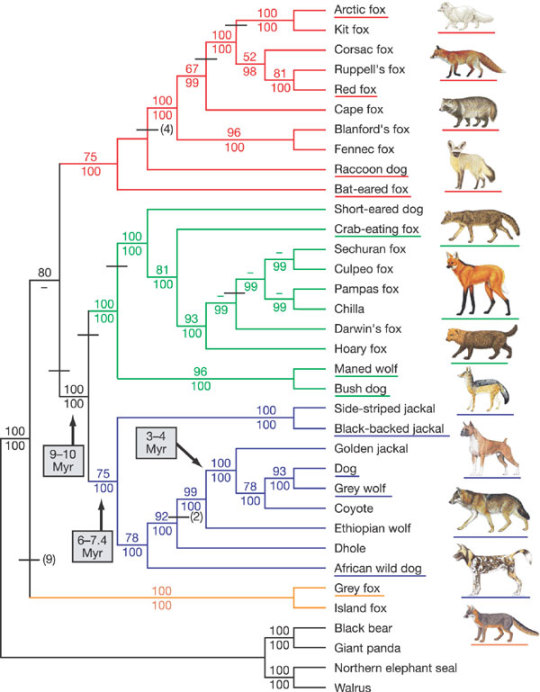
In fact, canids as a whole are kind of a mess when it comes to phylogeny. How many species of wolf there are really depends on who you ask – some populations traditionally classified as subspecies of the grey wolf, for example the Indian wolf (traditionally C. l. pallipes), the Himalayan or Tibetan wolf (traditionally C. l. chanco) and the Eastern wolf (traditionally C. l. lycaon) have been suggested instead to be classified as separate species – Canis indica, Canis himalayensis and Canis lycaon, respectively [24][25]. Likewise, just last year it was discovered that what was thought to be an African subspecies of the golden jackal (Canis aureus) had in fact been misidentified and was instead an undiscovered species of wolf, now the African golden wolf (Canis anthus) [26]. And then there’s also the fact that, despite being called “jackals”, the black-backed and side-striped jackals actually aren’t very closely related to the golden jackal, or indeed to any of the rest of the genus Canis [27]. In fact, going by the cladogram below, you can see that the African wild dog and dhole – both of which are classed in their own, unique genera (Lycaon and Cuon, respectively) – are actually placed closer to wolves, golden jackals and coyotes than black-backed and side-striped jackals are, even though both of the latter species are considered part of genus Canis (the black-backed jackal is C. mesomelas and the side-striped is C. adustus). Many sources also say that these two species differ from the rest of the group in that they have only 74 chromosomes, while wolves, coyotes, golden jackals, African wild dogs and dholes all have 78. This makes the moniker of genus Canis somewhat useless when trying to determine exactly how genetically similar these animals actually are to one another.
And this isn’t even touching the issue of the “red wolf” (Canis rufus), a critically endangered so-called “species” of wolf closely related to the grey wolf, eastern wolf and coyote, which more recent molecular and genetic analysis has revealed may simply be a wolf/coyote hybrid [29]. Of course these classifications aren’t set in stone, either – new studies and discoveries are constantly uprooting and rewriting our knowledge of phylogenetic and evolutionary relationships among species. Sometimes it’s also pretty much impossible to accurately represent the relationships between similar-but-distinct populations using only the terms “genus” and “species”, which is where alternate concepts like species complex, subgenus and superspecies come in.
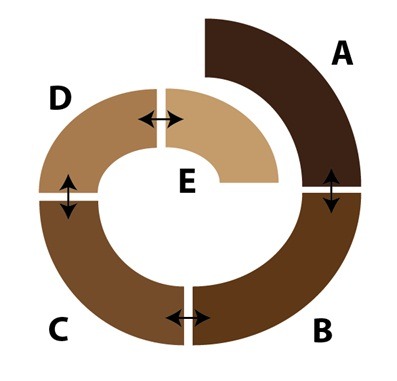
Another feature of evolution and speciation that makes classification difficult is what are known as ring species, in which a series of neighbouring populations of organisms may evolve divergently (i.e. undergo allopatric speciation) in such a way that each geographically adjacent or overlapping population can interbreed with the next, but the last population in the “ring” has diverged to the point that it can no longer interbreed with the first (basically, population A can interbreed with population B, B with C and C with D, but D can no longer interbreed with A).
When does the actual split occur, and at what point in the ring can we consider the populations to be different species? We just don’t know. (And in some cases this is considerably more messy and complicated than even the ring species model makes it seem [32]). The point is, though, that there is no definitive, universally agreed-upon cutoff point at which we can say with certainty that two organisms have evolved sufficiently as to become different species, any more than you can definitively say where along a rainbow spectrum of colours red becomes orange or orange becomes yellow. The decision whether to lump or split taxa becomes even more arbitrary in paleontology than it is with extant species [33][34] – when you’re working with an incomplete fossil record and pretty much going entirely on morphological similarities since genetic or molecular analysis often isn’t possible, there isn’t really a way to conclusively determine whether that specimen you found represents a new species, a new genus, or is simply a larger/smaller/juvenile/unfortunate-looking version of an already-described animal. Many specimens now believed to be juveniles of previously-described species were originally believed to be completely new ones – for example, Nanotyrannus is now often (but not universally) agreed to be a juvenile Tyrannosaurus rex [35], and Dracorex and Stygimoloch are considered immature specimens of Pachycephalosaurus [36]. And then there was the whole deal where Brontosaurus didn’t exist for a while and then it did again and it was all very confusing [37].
Obviously, at the end of the day, a zebra is materially different from a dog in the same way that, to get back to the original topic, a penis is materially different from a vagina (actually a bad analogy since homologous reproductive organs are much more similar to each other than taxa that have been separated for millions of years, but anyway). The biological differences and similarities themselves exist, but any attempt to categorise and quantify them will necessarily rely on socially constructed and frequently arbitrary models, definitions and assumptions. That’s basically what science is – a continuous (and frequently wildly inaccurate) attempt to try to make sense of reality. We often attempt to understand or make predictions about reality using mathematical or quantitative models of the situation or by sorting things into sets and categories, which is useful and necessary in many cases but is also often far too simplistic to be taken as any kind of gospel truth regarding the actual nature of reality, because simply put reality doesn’t care for or abide by human-made rules and categories. Essentially, we’re trying to find quantitative ways to represent things that are by nature qualitative, and that’s always going to be arbitrary to some extent. Obviously biological characteristics (whether genetic, sexual/reproductive, etc.) objectively exist and would continue to exist if humans and human culture were to suddenly disappear, and in that sense, things like sex, gender and taxonomic classification can be said to be basedin biological reality. But human attempts to define or categorise these characteristics – for example species concepts, the binary model of sex, etc. – are not in themselves biological realities, and are subject to change based on new information. For example, evolutionarily speaking, “reptiles” (as we traditionally understand them) don’t exist [38]. Obviously this doesn’t mean that lizards, tortoises, snakes, crocodiles, non-avian dinosaurs etc. don’t exist or never existed. It simply means that the socially constructed classification of animals into two distinct, mutually exclusive groups called “reptiles” and “birds” is completely arbitrary and not actually the result of any inherent biological reality (in fact the opposite).
I mean I know how crappy the highschool biology syllabus can be @valarie-lynn so I’ll also link you to the Wikipedia page on species and the species problem, and also to somemoreonsex and how it’s just as complicated and arbitrary as the concept of species (from Actual Biologists™) if you’re interested. I’ll also leave you with a quote from Charles Darwin:
“From these remarks it will be seen that I look at the term species as one arbitrarily given for the sake of convenience to a set of individuals closely resembling each other, and that it does not essentially differ from the word variety, which is given to less distinct and more fluctuating forms. The term variety, again, in comparison with mere individual differences, is also applied arbitrarily, and for convenience sake
Saving the thorn from obscurity Is surely a laudable aim But if this letter deserves our praise The eth should receive the same.
The scribes of the Anglo-Saxons interchanged the eth and thorn until the first one fell from use and the second was left forlorn,
But for the modern Icelander their roles are more defined and could improve our English texts if we were so inclined.
The thorn (Þ, þ) denotes a voiceless dental fricative as in the English ‘think’ or ‘thresh’ but not the ‘th’ in ‘hither,’ whereas the eth (Ð, ð) is a voiced dental fricative perfect for ‘this’ and ‘that’ and most especially for ‘thither.’
So I propose ðey boþ be used in the Icelandic manner; ðen students won’t be loaþ to learn our spelling and our grammar.
To þink we’ve never fixed ðis mess is really quite astounding. One letter cluster for two sounds? Ðat’s damnably confounding!
Þank you for ðis informative post!
Eventually, you will need to stop curating yourself for public consumption. You will need to stop people pleasing. You will need to stop trying to appear perfect all the time. You will need to be vulnerable. A breakdown will occur. Rock bottom will happen. You will be an anxious, stressed, sad and angry mess of a person, and you will rise. You will wish you had known better. You will wish someone would’ve told you that nobody gets to tell you who the f*ck you are. But you will rise, regardless.




 Aw Yiss