Don’t react to toxic people. Not giving them a reaction when they desperately seek it, is far more powerful.
Unknown (via deeplifequotes)
Don’t react to toxic people. Not giving them a reaction when they desperately seek it, is far more powerful.
hey like, if you happen to do something abusive because of your mental illness
you still gotta apologize for it????
you still have to accept responsibility???
you can’t expect the people around you to just suck it up when you hurt them because you’re mentally ill.
spiraling further and self-deprecation/calling urself a monster also isn’t an apology. an apology does not involve another person comforting you for your harmful actions.
same with claiming that you are a failure and are doomed to never change or improve. Apology should not involve the other person comforting you and rooting for you, and essentially being your cheerleader.
Same if you claim that not doing abusive things to someone repeatedly is “so hard” while also refusing to examine your behavior, to create a plan of action to help you cope with your mental illness in a healthy way, or by refusing to seek help in any shape or form. Twice as bad if you expect the person you abused to be your mental health therapist/processor.
Something that a lot of people don’t realize is that abusers are capable of being nice. Yes, abusers can do acts of kindness. These acts of kindness do not mean that they aren’t abusive. They’re still abusers.
If your parents constantly tell you that you’re worthless, but provide you with everything you want, they’re still abusive.
If your boyfriend screams at you whenever you do something he doesn’t like, but cuddles you and calls you beautiful, he’s still abusive.
If your friend threatens to never talk to you again when you try to talk to other people, but is always there for you when you need them, they’re still abusive.
Acts of kindness do not make up for their abuse. This is a method that abusers use to keep you attached to them and make you less likely to leave them. You are not a bad person for leaving someone if they cause constant harm to you. Their kindness does not outweigh the harm and pain they caused you. Their kindness does not justify their abuse. Abusers can do good things for their victims and still be abusers.
Abuse is *never* justifiable.
The idea that abusers are cartoon bad guys who are constantly terrible needs to die. Nobody would form an attachment to an abuser or find it difficult to leave one if they behaved badly all the time.
Follow your gut instincts with this type of thing, even if it’s hard. Even if you doubt yourself and others around you do to. Because there will come a day when you look back and realize that getting yourself far away from that situation was the smartest thing you’ve ever done.

18 years ago when I was coming out, y’all made the word “bisexual” so dirty that for years the only word I felt was accessible to me was “queer”, if I had any chance at having a community.
Queer was widely used at that point among LGBT+ people to refer to ourselves and our community, and while you’d look askance at a straight person using that word, it was most definitely acceptable to call another LGBT+ person queer.
And now y’all are telling me “Queer” isn’t an acceptable umbrella term to use and it just feels like another way you’re using subtle language policing to tell me that really the only people you want in your community are gold-star LG folks.
Those of us who like the word queer because it accurately reflects our misfit status are basically being told that this self-identifier is dirty and wrong, this is no longer the “queer community”, and the message yet again is that we don’t really belong.
I get it if someone doesn’t want to be called queer, and I would never call another person queer against their will but holy hell please stop acting like it’s common knowledge that queer can’t be used as an umbrella term for our community when it was for DECADES
“q-slur” is a very new concept, kids.
This is something
that’s completely overlooked, by the same people who fling the word
“ahistorical” at every viewpoint they disagree with.When I first started
participating in any kind of LGBTQ+ stuff online (so, 10 years ago),
“queer” was by far the most common descriptor. It was pretty much
agreed it had been reclaimed enough to be safe (I mean, show me an
active slur that has academic disciplines named after it?) and people
seemed much more keen to explore the ambiguity the term offers,
rather than sticking with predefined categories. By “q-slur”
logic, we should’ve been much less accepting of it back then if we
simultaneously believe that LGBTQ+ rights are advancing over time,
but the opposite is true.So I would say that the current
stigmatization of queer is based on two things: 1) reactionary
essentialism (seeing “queer” as too dangerous for the more
clear-cut categories), and 2) respectability politics.Now by taking away
“queer”, we don’t have any other term that’s both catchy (no
version of the abbreviation is) and broad enough to actually be
inclusive. Gay is not an umbrella term. It always has a default
connotation that’s very specific. It only reminds me of all the time
I wasted on bad gay-only discourse when I was first questioning my
own identity, and for this reason it took ages to arrive at the
conclusion that I’m just attracted to multiple genders and also trans without dysphoria (because the other bullshit I had to
contend with was the truscum narrative of transness). So, gay is not a safe
term for me. It doesn’t describe me and if I used it, it would
actually misgender my own relationship. I’m not doing that for any of
you, sorry.Do you know who the
majority of the people who still use “queer” are? Trans and MGA.
Yet again, we have a political line that privileges cis LG people who are fine with binary categories
over the most routinely erased parts of the community. Of course.This, I imagine, is also
why so many bi/pan and trans/nonbinary people aren’t against aces
being included. Chances are most of us, at least those who are 25+ or so,have experiences like this, with either being actively policed out
or just unable to find the right identifiers for ages because of the
stigma and general ignorance surrounding them.And now you’re
telling us we HAVE TO use gay, which isn’t a functional umbrella
term, because queer suddenly isn’t acceptable based on this new logic?
Do you even hear yourselves?–
“But!” I can already hear the gatekeepers protest, “This all
relies on a bunch of personal anecdotes!”In which case,
buddy, I have bad news for you about the vast majority of all modern
LGBTQ+ history.I first came upon Queer as both an umbrella term and a field of academic study. This was in the early 90s. There were queer studies, queer histories, “queering” of the text, queer theory…
And Queer, more so than other words, felt inclusive of people who, at the time, referred to themselves as “genderqueer” as well as people outside the binary, as well as bisexuals, who couldn’t claim gay or lesbian.
It was, at the time, being reclaimed at a time when all the words were being used as slurs, so there was a real reason to reclaim them.
I’ve problem with using words that people are comfortable using, but not at the cost of erasing parts of our history.
I guess now is the
time we’re hitting New Essentialism and Respectability Politics 2.0
from people who aren’t old enough to remember any of this.Yeah, that’s something a lot of folks in the younger generation don’t get.
When you campaign against words like “queer”, to those of us in the older generations, what it looks like you’re doing is trying to roll the nomenclature back to the bad old days when cisgender gay men were treated as the only “real” members of the community, and everybody else was lumped together as this peripheral pack of weirdos who were expected to be slobberingly grateful to their betters just to be acknowledged at all.
Hell, I clearly recall a time when the leaders of mainstream gay rights activism would routinely castigate even lesbians as parasites and invaders – and be applauded for doing so. It’s difficult to overstate just how deep it went.
And, like, that wasn’t all that long ago – I’m only 33 and I’m old enough to remember that horseshit.
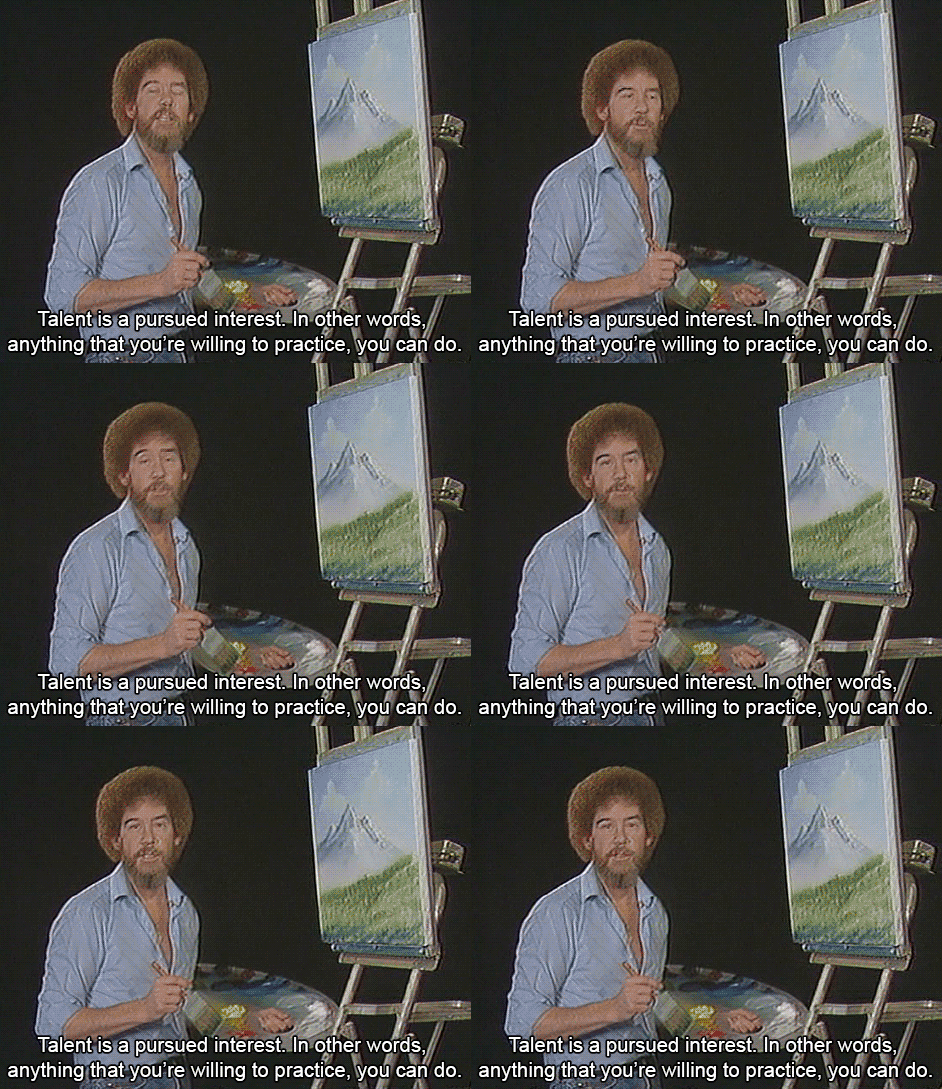
“people are so good at things how do i get talent :(”
everyones going through something be gentle
Well, Sansukh is one of those amazing, game-changing type of fics that stick with you years upon years later, so chock full of amazing OCs and fantastic worldbuilding and character development that it raises the damn bar of what you expect out of fic. Stories in general really. Sansukh is definitely on my shortlist of “Why the fuck isn’t this a published novel series/movie set/WHAT HAVE YOU yet?”
Honestly, though, you gotta look beyond the fic itself too. @determamfidd deserves all the praise she gets and more. Not only is her writing superb, but she is a humble, caring, altogether kind person…and I think that translates well into Sansukh’s popularity. (You can write stupendous things to begin with, but if you’re an asshole people won’t go near it.)
But still, be wary calling her famous! In a sense, yes she is. I mean DAMN PEOPLE HAVE SANSUKH QUOTES TATTOOED ON THEIR SKIN AND THEY COSPLAY AS HER OCs IT’S SO TERRIFIC AND AWESOME TO SEE, but under all that she’s still just as much a fan as you or I, anon.
I’ve seen it happen before. People with very popular fics get hate spewed at them because of how much others love what they make. It’s such Catch-22 bullshit and it’s a horrible thing to see, so I’m wary of saying stuff like she is famous all (I’m a bit wary posting this ask ngl. I’d hate to see it fall on Dets negatively). If anything, fandom-famous is a better thing to put. At least in my humble opinion.
I’m gonna post it anyway, however, because Dets deserves to see it. Because nice words are nice words! Sansukh AND its creator are great!

Oh
my god
pop
*brain departs my body and orbits the earth several times making this sound: AAAAAAAAAAAAAAAAAAAAAAAHHHHHHHHHHHHHH*
Mahal save me, oh my heart, my wonderful friend. What an amazing, amazingly kind, gorgeously thoughtful thing to say. l am allasldjhfgaskjhdfgashjsgdfkjasghdf *brain ascends ONCE MORE*
ajsgdfjhdahgakjsgdfkajsh really though. You beautiful, wonderful talented and gorgeous soul. I count myself very lucky to know you and to call you my friend. I count myself very lucky that people like my lengthy what-if blabberings. I count myself GOBSMACKED AND FORTUNATE BEYOND WORDS that people like my blabberings enough to draw, sing, podfic, etc… and I am gasping and flattened with awe and gratitude that I’ve ever written anything that resonated with one or two folks to the extent that that they decided to tattoo it on their bodies. That. THAT. Just makes me want. TO.
*brain departs, puts a girdle round the earth once more: AAAAAAAAAAAHHHHHHHHHHHHHHHHHHHH!!!!!!!!!!!!!!!!!!!!!!!!!!!!!!!!!*
I do get stupid hate messages, yeah. Not as bad as some (there’s some awesome folks who seem to get hate on a fucking weekly basis, which ????). It usually comes in waves. I brace myself every time i post a new chapter tbh. I used to get upset. But nowadays I just delete the bull and keep moving, so don’t worry, dude. The way they treat me and speak to me, like a thing or a machine or a corporation or some all-powerful Machiavellian manipulator, makes me feel… depersonalised and othered and not really real? I’m musing aloud here but yeah, it’s weird, it gets to the point where the hate is so removed from reality that I just detach. It’s just so preposterously OTT, it’s so evidently not real, it’s so not me. Like, I can barely manage myself and the hectic rush that my life has become, I have no time or energy for such nonsense? This idea of me is so skewed and rubbish. So I don’t take the spite to heart, I shrug, and I just move on. I’m a fan, and I’m doing exactly as other fans do.
idk, riffing on that idea: too, I feel it is amazingly, breathtakingly arrogant to speak for anyone other than yourself. That’s a personal belief, something I’ve held to for years. So when I see people declaring that they are the Sole True Representative of say, hmm, mental illness? (lol) in fandom AND THEREFORE BOSS OF EVERYTHING, ordering people about, silencing other mentally-ill people and trying to police other mentally-ill people’s fanfiction (wut), I can only eye-roll and think

And that stops me getting outraged at the arrogance of it.
Fandom ‘fame’ is funny, too. I’ve met truly famous folks before. The sort of people whose names have wikipedia entries. That’s fame, that’s perspective. Me, a small Aussie nerd, I have a Sansukh-sized playpen, tucked away in LOTR Niche Corner, somewhere in the vast and varied and gargantuan City-State of FANDOM which is itself a niche interest, let’s not forget lmao.
I like my playpen, and I’m so happy that others like visiting it.
Hello, my name is Poetry, and I love social insects. Whether they’re ants, bees, termites, wasps, aphids, thrips, or ambrosia beetles, I find them fascinating to learn about. But if the sci-fi books I read as a kid had had their way, I should have run screaming from every ant colony I saw.
From the buggers in Ender’s Game to the Borg in Star Trek to the Vord in Codex Alera to ants and termites themselves from a morph’s-eye view in Animorphs, social insects, and the aliens or artificial intelligences that closely resemble them, are portrayed as “hive minds” with an emotional tone of existential terror. And I’m here to tell you that these portrayals are totally unfair.
What they get right
Here are some features that most portrayals of social insects and their analogues in sci-fi get right. Yes, social insect colonies have queens that are primarily responsible for reproduction. Yes, social insects have very different sensory modalities from ours. We primarily use sight and sound to communicate and navigate the world, while social insects use taste and smell and vibration. Yes, social insects have specialized division of labor to particular tasks, and yes, they are willing to sacrifice themselves in droves to protect the colony. And sometimes, they will enslave social insects from other colonies or even species to serve their own ends (x).
Thus ends what sci-fi portrayals get right.
What they get wrong: Queens
Almost universally in sci-fi, when you kill the queen, the hive disintegrates into chaos. You’ve cut off the head! The central intelligence of the hive is gone! They’re just mindless borg-units with no idea what to do!
Indeed, in some social insects, such as leafcutter ants, if you kill the queen, the whole colony will die – but probably not for the reasons you think. However, it’s more common for social insects to be able to carry on just fine regardless. In most ants and bees, there are “backup” queens that are reared up by the workers in case the current queen should die. And in many social insects, a worker can step up and become a queen in her place. (Hilariously, a worker ant that steps up to reproduce in place of a queen ant is called a gamergate.)
But here is the most important problem with the sci-fi trope of killing the queen to kill the hive. The queen is not the brain of the hive. She is the ovary.
If you think of a social insect colony as a superorganism, which it’s useful to do in many cases, different groups of insects within the colony act like organs. One caste protects the colony from invaders, which is like an immune system. One caste scouts for new places to forage, which is like a sensory system. Generally, science fiction has a good grip on this idea. Where sci-fi authors fail is that they think the queen is the brain of this superorganism. She is not. She is the reproductive system. The queen does not control what happens in the hive any more than your reproductive system controls what happens in your body. (Which is to say, she has some influence, but she is not the brains of the operation.)
The reason why leafcutter ant colonies die when the queen dies is because the colony has been castrated, not beheaded. Most animals die when they are no longer able to reproduce, even if their brains are still perfectly functional. For castrated colonies with no backup queen or gamergate and no hope of getting one, there is no point in carrying on. Their evolutionary line has ended.
What they get wrong: Swarm intelligence
Here is how social insect hive minds work in science fiction: the queen does the thinking, and the rest of the hive goes along with whatever she thinks.
Now, I’ve already told you that the queen is not the brain of the hive. So where is the brain? Well, that is exactly the point of swarm intelligence. The brain does not reside in one particular animal. It’s an emergent property of many animals working together. A colony is not like your body, where your brain sends an impulse to your mouth telling it to move, and it moves. It’s more like when two big groups of people are walking toward each other, and they spontaneously organize themselves into lanes so no one has a collision (x). There’s no leader telling them to do that, but they do it anyway.
Much of the efficiency of social insect colonies comes from very simple behavioral rules (x). Hymenopterans, the group of insects that includes ants, bees, and wasps, have a behavioral rule: work on a task until it is completed, and when it is done, switch to a different task. If you force solitary bees (yes, most bee species are solitary) to live together, they will automatically arrange themselves into castes, because when one bee sees another bee doing a task like building the nest, its behavioral rule tells it that the task is completed and it needs to switch to a different task, like looking for food.
Individually, a social insect isn’t all that smart, whether it’s a queen, worker, soldier, or drone. But collectively, social insects can do incredibly smart things, like find the most efficient route from the colony to some food (x), or choose the perfect spot to build their hive (x).
What they get wrong: Individuality
The existential terror of the hive mind in science fiction comes from the loss of the self. The idea is that in a social insect colony, there is no individual, but one whole, united to one purpose. No dissent, disagreement, or conflicting interests occur, just total lockstep. I totally get why that’s scary.
The thing is, it’s just not true of real social insects. There is conflict within colonies all the time, up to and including civil war.
A common source of conflict within colonies is worker reproduction. Yes, in most social insects, workers can in fact reproduce, though usually they can only produce males. So why don’t they? Because it’s not in the interest of their fellow workers. Workers are more closely related to their siblings and half-siblings produced by the queen than they are to their nephews, so they pass on more of their genes if they spend resources on raising the queen’s eggs. So, if a worker catches its fellow laying an egg, it will eat the egg. Not exactly “all for one and one for all,” is it?
Worker insects may also fight in wars of succession. If there is more than one queen in a species where queens do not tolerate each other (yes, there are species where multiple queens get along together just fine), such as monogynous fire ants, the workers will ally themselves with one queen or another and engage in very deadly civil war.
Finally, in some species, the queen needs to bully the workers into doing their jobs, and the dominant workers need to bully subordinate workers into doing their jobs (x). Yes, sometimes workers try to laze around and mooch.
Surprisingly human
Here’s what I find weird about depictions of social insects in science fiction. They are portrayed as utterly alien, Other, and horrifying. Yet humans and social insects are very, very similar. The famous sociobiologists E.O. Wilson and Bernard Crespi have both described humans as chimpanzees that took on the lifestyle of ants.
I think what fascinates people, including me, about ants, bees, and their ilk is that you watch, say, a hundred ants working together to tear up a leaf into tiny bits and carry it back to their colony, or a hundred bees all appearing out of seemingly nowhere to sacrifice themselves en masse to stop a bear from eating their hive, and it looks like magic. It really does look like some kind of overmind is controlling their collective actions.
But imagine you’re an alien who comes to Earth, and you know nothing about humans or the way we communicate. Wouldn’t we look exactly the same to them as ants and bees look to us? Wouldn’t they look at us sacrificing our lives by the thousands in wars, or working together to build cities from nothing, and think, Wow, how do they coordinate themselves in such huge numbers, why do they give up their lives to defend their borderlines, I guess there must be some kind of mega-brain they all share that tells them what to do, and they just march in lockstep and do it.
If there’s anything I’ve learned from the study of both social insects and humans, it’s that any system that looks monolithic and simple from a distance is in fact fractured, messy, and complicated when you look at it up close.
Social insects aren’t scary mindless robot-aliens. They’re a lot like you and me. As much as I was terrified as a kid by the Animorphs book where an ant morphs into Cassie and screams in pure existential horror at its sudden individuality, I actually think an ant would adjust very easily to being a human, and that a human would adjust very easily to being an ant – much more easily, in fact, than humans adjusted to morphing, say, sharks, in the very same book series.

 Aw Yiss